


Preface
Briefing description and more.
This briefing provides tactics and practical suggestions for engaging with others in conversations about veganism and animal ethics in a way that inspires action.
Companion Videos
Briefing Meta
Counts:
| Main Text | |
| Key Tactics | 25 |
| Counterclaims | 0 |
| Supplementary | 9 |
| Further Study | 11 |
| Footnotes | 3 |
| Media & Advocacy | |
| Advocacy Notes | 0 |
| —Socratic Questions | 0 |
| Flashcards | 0 |
| Presentation Slides | 0 |
| Memes & Infographics | 0 |
| Companion Videos | 0 |
Activity Log:
Key Points Links
Loading…
Help Us Improve
Please send your suggestions for improvements, or report any issues with this briefing to [email protected]
We appreciate that you are taking the time to help us improve. All suggestions and reports will be carefully considered.
The closely related briefing, Words of Concern in Vegan and Animal Advocacy, provides practical guidelines for using certain often‑discussed and frequently debated words and terms of concern.
Summary
A concise summary of the briefing (see below for citations).
Even if you do not consider yourself an activist, you may still be called upon to explain your choices, answer questions about veganism, or discuss animal ethics with friends, family, coworkers, or strangers. Volunteers and activists may have these conversations during tabling, street outreach, or other forms of organized advocacy. Whether the conversations are planned or spontaneous, the information presented in this briefing can help.
This briefing provides practical guidance for choosing when and how to engage, creating openings for discussion, building enough trust for difficult truths to be heard, and keeping the conversation focused on animals. It also explains how to use facts carefully, respond to resistance, and end with a clear next step.
Context
Places this topic in its larger context.
Conversations about veganism and animal ethics can be difficult because they involve questions of morality, identity, culture, habit, tradition, and personal responsibility.
The tactics and suggestions presented in this briefing draw on the author’s outreach experience, familiarity with the relevant research and literature, and lessons learned from the experiences of other advocates.
Key Points
This section provides talking points.
Don’t wait until you feel ready.
This is less a tactic than a footing for the tactics that follow. Many advocates hesitate to start conversations because they worry they do not know enough or will be unable to answer every question. Watching experienced advocates online can reinforce that feeling.
No one has all the answers, and productive conversations rarely depend on having them. They are more likely to result from thoughtful questions, careful listening, staying focused on the animals, and responding honestly when you do not know something. Confidence grows with experience.
Sprinkled throughout this briefing, we’ll cover how to use the resources on this website to help you prepare, but do not wait until you feel completely prepared. You can begin by starting where you are, learning as you go, and using each conversation to become more effective.
Consider the audience and setting first.
How you approach a conversation depends on who you’re talking to. You don’t have to change your principles for different audiences. Just convey information in a way that the audience can understand.
Family
Family members can be among the least receptive people to conversations about veganism and animal ethics. This is not because they care less. Rather, the relationship gives the conversation more weight. Relatives may feel judged, worry that family traditions are being criticized, or anticipate unwelcome changes to meals or routines.
Try to have the conversation when a natural opening appears; pressing the issue can work against the long game. The better approach is to make clear that you are open to further discussion, answer sincere questions when they arise, and set an example through your own choices.
Another approach is to have a dedicated conversation whose stated purpose is simply to help your family understand why your way of thinking about animals has changed and how that will affect your choices. Avoid asking them to make the same changes or implying that they should during this exchange. This leaves the door open for future conversations.
Because family members care about you and now know someone who is vegan, they may pay more attention to documentaries, news stories, social media posts, or other exposures they might otherwise ignore. Your presence can make the issue harder to ignore over time.
Friends
The closeness of a friendship will affect your approach. With a close friend, you may hesitate to risk tension or misunderstanding, yet that trust can allow for a more open and honest conversation.
You may be able to take an approach similar to the dedicated conversation suggested for family members: explain that you value the friendship and want them to understand why your way of thinking about animals has changed.
With more casual friends, there is often less at stake if the conversation is not well received. That can make it easier to be more direct.
Friends also provide natural openings. A friend may express concern about justice, nonviolence, climate change, health, or another value that intersects with veganism. These moments create opportunities to connect the issue to something the friend already cares about.
Acquaintances
Acquaintances often call for more patience than friends. You may know enough about each other to have a meaningful discussion, but not enough to predict how the topic will be received. Listen, ask questions, and learn what the other person values before deciding how deeply to go.
Acquaintances can become friends, so think beyond the immediate conversation. If they seem open, continue. If they push back or lose interest, it is usually better to leave them with a good food-for-thought question than to press for agreement.
As with friends, natural openings often work best. Look for moments when the person expresses interest in your food choices or concern about animals, health, the environment, fairness, or another topic that connects naturally with veganism and animal ethics.
Coworkers
Coworkers require additional judgment because the conversation takes place in a professional environment. Workplace dynamics can be tricky, especially when supervisors, employees, or advancement are involved. A bad interaction can also make day-to-day work uncomfortable. Consider whether the setting is appropriate and whether the other person seems interested before raising veganism or animal ethics.
When opportunities arise naturally, keep the conversation respectful, professional, and proportionate to the situation. A question over lunch or during a break is different from a discussion that interrupts work or makes others uncomfortable. If a coworker shows genuine interest, you can continue the conversation outside the workplace or at another time.
Strangers
Conversations with strangers can occur almost anywhere: during outreach, while traveling, at social gatherings, in restaurants or coffee shops, while waiting in line, or through unexpected comments in everyday life. Many begin with a natural opening, as discussed in the next tactic.
These conversations may never continue beyond the initial interaction. That can make it easier to be direct, try different approaches, and learn from the response. Because you do not know each other, you will need to break the ice quickly and avoid assumptions about what they already believe.
Initiate conversations with the segue in mind.
Note: This tactic applies mostly to activists who are actively looking for opportunities to engage.
During organized outreach, people generally understand why you are there, so you can begin discussing animal ethics with little or no small talk. Otherwise, opening with your intended topic can feel abrupt. You can usually tell early if someone is not in the mood to talk, and you should respect that.
Look for ways to begin a conversation that can naturally segue into animal ethics or veganism. Topics that lend themselves to this include companion animals, wildlife, nature, food, health, the environment, social justice, and shared values.
Use Your Shared Situation
The easiest way to start a conversation is to comment on something you both are experiencing in that exact moment. It feels natural and unforced.
- “Those are beautiful dogs. Are they rescues?”
- “Have you tried the plant-based burgers here?”
- “I love this farmer’s market. The veggies are so awesome here it make you wonder why anyone would eat meat.”
- “I noticed you choose the oat milk, which is my favorite. Are you vegan?”
Compliment Then Question
Compliments are good, but a standalone compliment can sometimes end a conversation immediately (“I like your shoes.” -> “Thanks!”). Pair the compliment with a question to keep the momentum going.
- “I love your fur coat. Isn’t it great they can make it look so real now and don’t have to harm animals?”
- [After concern for an animal has been shown]. “That was really kind of you. Have you always been an animal lover?” Then, if they say yes and you’re brave, you can say “That’s great, thank you so much for being vegan!”
- “I keep forgetting my shopping bag, but I see you didn’t. Have you always be so environmentally minded?”
- “That’s a beautiful basket of vegetables. Do you cook much?”
Ask for a Small Favor or Opinion
People naturally want to be helpful, and asking for help, for a recommendation, or their opinion shows you value their input.
- In the grocery store’s yogurt aisle: “I’m trying to find the best plant-based yogurt. Have you found one you like?”
- Ask the clerk: “I’m looking for a body wash, but it has to be cruelty-free. Any recommendations.”
- At a book club meeting: “I noticed the author barely mentions farmed animal sanctuaries, but went into detail about companion animals. Do you think that was intentional?”
Notice Their Interests
Pay attention to what the person is carrying or wearing. People often use accessories, books, or graphic tees as silent signals of their interests.
- In the coffee shop: “I noticed you’re reading a book on the environment. Just curious, does it discuss the impact of animal agriculture?”
- “I noticed your ‘Adopt, Don’t Shop’ sticker. Do you consider yourself to be an animal lover?”
- “I noticed yourTennessee Titans shirt. I read somewhere that most of the team is plant-based.”
Build enough rapport for difficult truths to be well received.
People are generally more receptive to difficult ideas when they feel comfortable with the person presenting them. Even a small amount of rapport building can reduce defensiveness and encourage genuine dialogue. For this reason, building rapport is one of the most effective communication skills an advocate can develop. We explore it in much greater detail in the separate briefing, Building Rapport in Advocacy and Outreach.
In the previous tactic, we often chose conversation starters with a natural segue in mind. Another approach is to begin with almost any genuine shared interest, spend a little time building rapport, and then introduce animal ethics. This works especially well in street outreach and tabling, where people generally expect the conversation to move in that direction.
The shared interest can come from something the person is wearing, carrying, reading, or doing, from the setting itself, or even from an overheard comment. The specific topic matters less than creating a moment of genuine human connection before discussing more challenging ideas.
Once some rapport has been established, you might say something like, “You seem like a compassionate person. I volunteer in animal protection, and I was wondering if I could ask you a couple of questions.”
Know when to disengage.
Not every conversation should continue. It is best to recognize this early, but you should continue assessing the conversation throughout. Some discussions that begin on a promising note become unproductive, while others that begin badly become engaging.
There is no need to continue simply because the conversation has begun. If the conditions for a meaningful discussion are not present, end it politely and move on. This allows you to spend your time and energy where they are more likely to make a difference.
When ending a conversation, remain courteous. Thank the person for their time, wish them well, and leave the door open to future discussions.
Some signs that it may be time to disengage include:
- The person shows little or no interest in having a genuine discussion.
- They repeatedly interrupt or refuse to let you finish a thought.
- They ignore your answers and simply move from one objection to another.
- The conversation becomes primarily about winning or provoking a reaction.
- They resort to insults or personal attacks.
- They appear rushed, distracted, intoxicated, or otherwise unable to engage thoughtfully.
Remain calm and collected.
While words deliver the message, the emotional state you project dictates how deeply and efficiently that message is received and felt.1 People are generally more receptive when you remain calm, patient, and respectful, even when they strongly disagree.2 Becoming frustrated or defensive can shift attention away from the animals and onto you.
Realize that some people have never examined the ethical questions surrounding our exploitation of animals, and related ideas that seem obvious to you may be new to them. Remaining calm helps keep the focus on the ideas being discussed.
If you find yourself becoming emotionally invested in winning the discussion, pause and redirect the conversation, or end it respectfully. A calm ending is more likely to leave the door open to future conversations than an exchange that leaves everyone discouraged.
Find out and address what’s holding them back.
People reject veganism for different reasons. One person may have concerns about health, another about convenience, culture, or tradition. Another may simply never have thought much about the issue. The same response will not be equally effective for everyone.
Early in the conversation, before presenting facts or making an ethical argument, try to understand the beliefs and concerns shaping the person’s views.
A few thoughtful questions can help you identify what is keeping them from being more receptive to veganism or animal ethics. For example, if someone thinks they need animal products to be healthy, they probably will not be receptive to ethical arguments until that concern is addressed.
Not every conversation requires using these kinds of questions, and they should not feel like an interrogation. Use them naturally and selectively as the conversation develops.
| Question | What It May Reveal |
| Do you think people can be healthy without animal products? | If ‘no’, then address it quickly before moving on. |
| What are your thoughts on veganism? | Provides a broad overview of their attitudes and concerns. |
| Have you ever considered going vegan? | Indicates whether the idea is new, previously considered, or already rejected. |
| What do you think would be the hardest part of being vegan? | Reveals perceived practical obstacles such as taste, convenience, social pressure, cost, or nutrition. |
| What health concerns would you have about a vegan diet? | Reveals specific nutritional beliefs that may need to be addressed. |
| Do environmental issues influence your food choices at all? | Indicates whether environmental arguments are likely to resonate. |
| Do you think animals deserve moral consideration? | Helps uncover their underlying ethical framework. |
| Do you see any ethical concerns with how animals are treated today? | Determines whether they recognize problems in modern animal agriculture. |
| What do you think keeps most people from going vegan? | Often reveals the person’s own concerns indirectly and with less defensiveness. |
| What do you think is the biggest obstacle to veganism? | Helps identify the issue they see as most important. |
| If all the challenges could be solved, do you think we would have an obligation to avoid harming animals when possible? | Helps distinguish practical concerns from deeper ethical disagreements. |
Mind your word choices.
The words we choose can influence whether people focus on the animals or get sidetracked by terminology.
Using our suggestions about word choice should not make terminology a point of contention in the conversation. Instead, they should be integrated naturally into your overall approach so that your language communicates clearly.
Word choices are covered in much greater detail in Words of Concern in Vegan and Animal Advocacy and are only abbreviated here.
Some considerations include:
- Use veganism clearly. People often use vegan to refer only to food, while terms such as plant-based and vegan diet describe dietary choices rather than opposition to animal exploitation. When appropriate, clarify that veganism is an ethical position that extends beyond diet.
- Refer to animals in ways that recognize them as individuals. Avoid language that treats animals merely as products, commodities, or objects. Names, personal pronouns, and terms such as farmed animals can help keep the focus on what is being done to them.
- Use sensitive comparisons with care. Terms such as slavery, Holocaust, genocide, rape, murder, and concentration camp can provoke strong reactions. They should be used only when they help clarify the relevant similarity rather than shift attention away from animals and toward the word itself. One way to cool emotional reactions that may arise during a conversation is to clarify that you are comparing, not equating.
- Avoid inaccurate or juvenile labels. Phrases such as chicken periods or bee vomit are likely to distract from the ethical issue and can make the advocate seem less credible.
- Use movement terms judiciously. Words such as speciesism, abolitionist, and animal liberation can be valuable, but unfamiliar terms should usually be explained before they are relied on.
Avoid blaming and judging
When sufficient rapport has been established in a conversation, you may choose to use a more direct approach if it is communicated with the right tone. In many, if not most, contexts, however, phrasing should avoid implying blame or moral judgment.
Note: This does not mean you should not hold them accountable, just that you should do so carefully, and after a measure of rapport has been established. See the tactic on “Help them recognize their own complicity.”
When discussing harm, frame it in a way that encourages reflection rather than defensiveness.
Choices: Consider when to use “You are contributing to animal suffering every time you eat meat,” instead of “Eating meat supports systems that involve significant animal suffering.”
Awareness: Consider when to use “People who buy these products are choosing to ignore cruelty,” instead of “Many of these practices are not widely known, and the system often keeps them out of view.”
Moral Framing: Consider when to use “If you cared about animals, you wouldn’t eat them,” instead of “Many people who care about animals are surprised to learn how these practices affect them.”
Responsibility: Consider when to use “You are responsible for what happens to animals in factory farms,” instead of “Consumer demand plays a role in sustaining systems like factory farming.”
Health: Consider when to use “You’re harming your health by eating animal products,” instead of “Research suggests that diets higher in plant-based foods are associated with better health outcomes.”
Environment: Consider when to use “Your food choices are destroying the planet,” instead of “Food systems, particularly those involving animal agriculture, contribute significantly to environmental damage.”
Ethical Prompt: Consider when to use “Why would you support something so cruel?” instead of “How do you think our food choices relate to the treatment of animals?”
Consistency: Consider when to use “Some say they love animals but still eat them — that’s hypocritical,” instead of “Many people care about animals while also participating in systems that harm them, often without fully examining the connection.”
Industry Framing: Consider when to use “You’re paying for animals to be abused,” instead of “Purchasing these products helps fund practices that can involve significant harm to animals.”
Invitation: Consider when to use “You should stop eating animal products,” instead of “If it’s possible to meet our needs without causing harm, it’s worth considering what changes might be practicable.”
Avoid Identity Framing
Word choices should prioritize understanding, accuracy, and usefulness in conversation rather than signaling affiliation or ideology. While identity can provide community, belonging, and commitment, advocacy is often more effective when it focuses on animals and the reasons people choose to avoid exploiting them.
People are often resistant to adopting a new identity, especially when change is perceived to threaten continuity, status, or belonging.3 So language should help them understand veganism as a practice grounded in ethical principles rather than a totally new identity. Focus first on the ethical concern and the practices that flow from it.
The point is not to hide a vegan identity, but to be thoughtful about emphasis. When people first understand the concern, the label becomes easier to understand. When veganism is presented as an identity, it may activate assumptions, stereotypes, or resistance before the ethical issue has been considered.
This does not mean identity-based language should never be used. Discussions about community, movement-building, discrimination, or shared experiences may naturally call for identity-based language. But it’s better to present veganism as something people do because of ethical considerations, rather than simply as a category of people.
“I Am Vegan” versus “I Am a Vegan”
The difference between I am vegan and I am a vegan is a small example of the broader distinction between ethics and practice on one hand, and identity on the other. When referring to oneself or another person, I am vegan is preferable.
I am vegan presents veganism as an ethical practice and describes how a person tries to live in relation to other animals. I am a vegan can sound more like a social label or group identity. This can make a conversation feel more about belonging to a category than about the ethical concern behind the practice.
Other Examples:
- Practice vs Identity: Instead of “As vegans, we oppose animal exploitation.” say “Using animals for food, clothing, or entertainment raises serious ethical concerns.”
- Identity Signaling: Instead of “As a vegan, I oppose the exploitation of animals,” say “Using animals for food involves practices that cause significant harm.”
- Ideological Framing: Instead of “Animal liberation requires dismantling speciesism,” say “Many practices involving animals are based on treating them as having less moral value.”
- In-Group Language: Instead of “We need to challenge carnism,” say “Many cultural norms encourage eating animals without questioning the practice.”
- Abstract Terminology: Instead of “This reflects systemic oppression of sentient beings,” say “These systems cause harm to animals who can feel pain and distress.”
- Advocacy Identity: Instead of “Animal rights advocates believe this is unjust,” say “These practices raise ethical concerns about how animals are treated.”
- Jargon-Heavy Phrasing: Instead of “This is a clear case of anti-speciesist ethics,” say “This reflects the idea that animals’ interests should be considered alongside human interests.”
- Movement Language: Instead of “This is part of the broader animal liberation movement,” say “This is part of ongoing efforts to reduce harm to animals.”
- Polarizing Phrasing: Instead of “The meat industry exploits animals for profit,” say “The meat industry involves practices that prioritize production and profit, often at the expense of animals’ well-being.”
- Identity-Based Appeal: Instead of “If you care about justice, you should go vegan,” say “If reducing harm matters to you, it may be worth considering how food choices affect animals.”
- Label-Driven Explanation: Instead of “This is a speciesist practice,” say “This practice treats animals’ interests as less important than similar human interests.”
Use Socratic questions to guide the person toward their own conclusions.
The Socratic method uses thoughtful questions to encourage reflection and examine beliefs. These questions differ from the earlier questions used to find out what is holding someone back. Socratic questions help the person reach their own conclusions rather than being told what to think.
This approach can reduce defensiveness and encourage genuine engagement. Questions invite participation, while statements often invite rebuttal.
Every non-advocacy briefing on this website includes Socratic questions tailored to its specific topics. These questions appear in the Advocacy Resources section of each briefing. The few examples below are drawn from those briefings, each of which provides additional questions that can be adapted for conversations.
Questions Copied From Specific Briefings | Why? |
| /plants: “How is it that plants could feel pain when they don’t have pain receptors, or have emotions when they don’t have a brain?“ | This highlights the difference between reaction and sentience, making their argument fall apart. |
| /protein: “Why do you think that major health organizations like Harvard, the Mayo Clinic, and the Academy of Nutrition and Dietetics endorse a vegan diet if it were deficient or incomplete in protein?” | This undermines the credibility of the “incomplete protein” myth. |
| /protein: “If animal protein is necessary, how is it that the largest, strongest animals—elephants, gorillas, and rhinos—get all their protein from plants?” | This reframes plant protein as the original and primary source of protein, not a ‘lesser’ option. |
| /economy: “Would you rather support an economy built on needless animal suffering, or one that reflects growing values of compassion and sustainability?” | It invites reflection on values, not just outcomes. |
| /nature: “Many things occur in nature—violence, infanticide, and forced mating.45Would you say those are ethical simply because they happen?” | This shows that naturalness does not determine morality. |
| /expensive: “If you replaced meat with staples like beans, rice, potatoes, and oats, do you really think your grocery bill would go up?” | This helps them realize that vegan diets are naturally budget-friendly when based on whole foods. |
Find points of agreement and acknowledge shared experiences.
Earlier, we discussed building rapport as a way to begin conversations and make difficult truths easier to hear. That process does not end once the conversation turns to veganism and animal ethics. Throughout the discussion, continue looking for opportunities to identify areas of agreement and acknowledge experiences you have in common.
Finding common ground helps reduce defensiveness and reinforces the idea that you and the other person are working through the issue together rather than debating from opposing sides. It can also make it easier to challenge assumptions and hold people accountable later in the conversation.
Find Points of Agreement
When you recognize a valid point, acknowledge it. Doing so demonstrates that you are listening and that your goal is understanding rather than simply waiting for your turn to respond.
Examples:
- “You’re right that vegans need a reliable source of vitamin B12. Fortunately, supplements are inexpensive and readily available.”
- “You have a point. Some people do return to eating animal products. Why do you think that happens?”
- “I agree that convenience can be a challenge, especially in some situations.”
- “You’re right that many people care about animals. The question is how that concern translates into our daily choices.”
Acknowledge Shared Experiences
One way to connect with people is to confess that you once held similar beliefs, concerns, or habits. This shows empathy and helps the other person feel understood rather than judged.
Examples:
- “I know what you mean. I used to think I could never go vegan either.”
- “I understand that concern because I had the same question when I first looked into veganism.”
- “I also used to think animals needed to be treated better, but I had never questioned whether we should be using them at all.”
- “I know what you mean about cheese. That was one of the things I thought would be hardest to give up.”
- “I enjoyed the taste of meat too. For me, the question eventually became whether enjoying a beef hamburger justified taking a life.”
- “I remember feeling exactly that way until I learned more about how animals are raised and slaughtered.”
Use facts and evidence judiciously.
Facts are important, but they are most effective when they support a conversation rather than replace one. Advocates may make the mistake of overwhelming people with facts and statistics. Here are some tips to help you avoid this problem.
Let vBriefings.org be your crutch.
Share the information you know and then refer people to the relevant briefing at vbriefings.org for supporting evidence, citations, and additional information. This allows you to focus on the conversation rather than worrying about perfect recall.
Commit key facts to memory with vBriefings flashcards.
While you can and should use vBriefings as a crutch, advocates who want to reach the next level should consider using flashcards provided by the vBriefings platform.
Flashcards are not available for every briefing. For briefings that include them, they are linked in the Advocacy Resources section. You can also use the status report to quickly see which briefings currently have cards.
vBriefings partners with Brainscape because of its advanced learning features, including spaced repetition, randomization, and multi-deck study. A free account is all you need.
When someone challenges the numbers, help them put it in perspective.
People sometimes focus on a specific figure rather than the broader point being made. When this happens, explore whether the exact number is really the issue.
Questions can help keep the conversation focused on the underlying concern, for example:
- “What number would you find acceptable?”
- “If the actual number were half that, would it change your conclusion?”
- “Do you disagree with the statistic itself, or with the point it is intended to illustrate?
Respond to objections expediently.
During a conversation, objections will inevitably arise. When an objection appears to be a superficial repetition of something the person has heard rather than the result of meaningful reflection, it may not be worth spending much time on. Give a brief response before steering the conversation back to ethics. More considered objections deserve just a little more attention.
Distractions: Some people will try to distract from your response to an objection rather than acknowledge it. Watch for two common patterns:
- Pivoting to another objection before acknowledging the response. When this happens, call out the shift and bring them back: “You are trying to pivot on me and change the subject. Before we can move on, do you acknowledge that [brief restatement of your response]?”
- Gish-galloping. This means raising several unrelated objections in rapid succession, attempting to overwhelm you. When this happens, slow the conversation down: “Sure, there are good answers for all that. Which one would you like me to address first?” After one objection is covered, they will often forget about the others, and you can bring the conversation back to ethics.
The objection briefings on this website provide multiple talking points for responding to each covered objection. There is rarely a need to present every point provided in the briefing. We generally place the more important points first, but the most useful point depends on how the person presents the objection. Keep in mind that many objections have nothing to do with veganism. Tailor the answer accordingly.
- Examples:
- If someone says, “Almonds use so much water,” use the first talking point in the /almonds briefing: “This is not a vegan issue.” If they persist, decide if it’s worth going to a later talking point: “Compared to almond milk, cow’s milk has a much higher environmental impact, even for water.”6
- If someone says “transitioning to veganism would devastate the economy,” pick up on the word transitioning, and use this key point in the /economy briefing: “Economies have historically weathered transitions and emerged stronger.”
Consider bypassing misinformation rather than correcting it.
Not every false claim needs to be directly refuted. Sometimes it is more effective to redirect attention to a different, well-supported belief that leads away from the misinformation’s conclusion.
A 2026 research summary by Faunalytics describes this approach as “bypassing.” The underlying studies found that bypassing reduced the effects of misinformation on attitudes and policy support as effectively as direct correction. Correction worked by reducing belief in the misinformation, while bypassing worked by strengthening or bringing to mind another relevant belief.7
For example, if someone claims that humans have always eaten animals, you could debate the claim and its implications. Alternatively, you might ask, “Whatever people needed to do in the past, should we avoid harming animals when practical alternatives exist?” This redirects attention to a belief the person may already hold—that avoidable harm is wrong—without requiring agreement about the original claim.
Bypassing does not mean conceding that a false claim is true. Correct misinformation when necessary, especially when it is central to the person’s concern. When it is peripheral, redirecting the conversation may be more productive than trying to win the factual dispute.
Consider bypassing when:
- Resolving the factual dispute is unnecessary to reach the ethical point.
- Direct correction is likely to provoke defensiveness.
- The false claim is tied to identity, ideology, or conspiracy thinking.
- A shared value or accepted fact provides a natural route back to the animals.
Keep the conversation focused on the animals.
Health, environmental, and other practical considerations can be valuable parts of a conversation, removing concerns that would prevent someone from reconsidering their relationship with animals. If a person is especially interested in these topics, it may be worthwhile to spend additional time on them.
- For example, if they are concerned about the environment and are unaware of the environmental destruction caused by animal agriculture, spend a little more time on that topic before pivoting to animal ethics.
As early as practical, bring the conversation back to the ethics of exploiting animals. Veganism is fundamentally about how we treat animals, and the ethical case is the strongest and most difficult to dismiss. A person may debate nutritional studies and environmental projections, but it is harder to deny that animals used for food, clothing, and other purposes are disrespected and harmed by being abused and slaughtered.
Most briefings on this website suggest multiple segues back to ethics. Look in the Advocacy Notes section under Advocacy Resources.
Examples copied from specific briefings:
- /environment: “If we care about the destruction of forests and oceans, shouldn’t we also care about the destruction of the lives of billions of sentient beings?”
- /kill: “Even if incidental deaths occur during plant harvesting, how does that justify our intentional breeding, abuse, and violent slaughter of billions of farmed animals each year—animals who, incidentally, eat even more harvested crops?”
- /protein: “The protein question often falsely implies that eating animals is necessary. But since we can get all the protein we need from plants, shouldn’t we ask whether we have the right to exploit and kill animals at all?”
- /expensive: “If eating vegan really were more expensive, would that justify harming animals?”
- /souls: “If someone was kicking a dog, would you stop them? Or would you say, ‘It’s fine, the dog doesn’t have a soul’?”
- /economy: “If we know animals suffer in industries we no longer need for survival, isn’t the real question whether it’s right to keep exploiting them at all?”
Help them see that vegan values are their values.
Most people already hold values that are consistent with veganism and inconsistent with not being vegan. The task is to help them see that being vegan follows from values they already hold, while not being vegan goes against those same values.
A useful pattern is:
- “I’m not asking you to adopt my values, only to live out your own values—values you already hold. For example, [name the value].”
- Then use something similar to the continuation talk shown below, and close with “Does that seem consistent with [value]?”
Example continuation talk:
- Nonviolence. “If you are against needless violence, then animal exploitation involves an enormous amount of needless violence, including confinement, mutilations without pain relief, separation of mothers and babies, transport under stressful conditions, and slaughter.”
- Justice. “If you are for justice and against injustice, then exploiting animals means treating them as resources to be used for our benefit rather than as individuals with interests of their own. Their interests are disregarded simply because they belong to a different species.”
- Compassion. “Most people consider themselves compassionate, but compassion involves concern for the suffering of others. Animals used for food, clothing, and other purposes are routinely subjected to suffering that we can easily avoid supporting.”
- Fairness. “Is it fair that some animals, such as companion animals, are protected and cherished, while other animals receive little or no protection from practices that would be considered criminal if done to those same companion animals? For example, pigs are often confined in gestation crates so small they cannot turn around and are slaughtered by gassing.”
- Personal responsibility. “If we pay someone to harm a human, we are morally complicit in that harm. Shouldn’t the same apply to animals? For example, when we pay someone to breed, confine, transport, and slaughter animals on our behalf, our purchase helps support those practices.”
Encourage empathy.
As part of keeping the focus on the animals, help people consider the situation from the victims’ perspective. Many discussions about veganism become centered on human preferences, traditions, convenience, or practical concerns. While those topics can be important, it is easy to lose sight of the individuals whose lives are most directly affected. The following are some examples of questions you could ask:
- “If you were in that situation, how would you want to be treated?”
- “How do you think the animal experiences that situation?”
- “Do you think the animal would choose that if given the option?”
- “If a dog or cat were treated the same way, how do you think people would react?”
- “What do you think life is like for the animal involved?”
- “Do you think the animal’s interests matter in this situation? If so, how much?”
- “When we talk about this issue, whose perspective do you think is most often overlooked?”
- “If someone did that to a human with similar cognitive abilities, how would we view it?”
- “What do you think the animal loses by being used in that way?”
- “If the roles were reversed, what would seem fair?”
Use graphic content strategically.
In street outreach conducted with other organizations, graphic footage or images may be part of the standard approach. Even in a one-on-one conversation, you may have an opportunity to show such content on a laptop, tablet, or phone.
This tactic can be a powerful way to help people understand the reality of animal exploitation. Our experience is that graphic content can help by making viewers aware of atrocities that are common practice, showing that they are systemic rather than exceptional, and leaving an emotional impression that facts alone may not create. As you likely already know, it can also provoke defensiveness, so use it carefully.
When combined with other tactics, graphic content can be especially effective when you help people understand what they can do with the information. The goal is not merely to shock people, but to help them think more deeply about animal exploitation and their role in it.
Here are some ways to incorporate graphic content into a conversation:
- Ask them to watch a documentary such as Dominion. You can also write this recommendation on an outreach card.
- If you have a laptop, tablet, or phone available, ask them to watch a shorter documentary clip with you, such as What Cody Saw.
- Show them still images that illustrate common industry practices. For example, searching for “pigs being gassed” will quickly produce relevant images.
This tactic should be viewed as one tool among many rather than a complete advocacy strategy.
Present Veganism as a Reasonable Standard
Avoid phrasing that implies absolute or idealized standards when the relevant standard is a reasonable effort under real-world conditions. At the same time, avoid language that weakens the expectation or suggests that meaningful change is optional. The goal is to communicate a clear standard: harm should be avoided when it is reasonably possible to do so, not only when it is convenient.
Unrealistic standards can make veganism seem unattainable, while overly permissive language can make it seem optional. Effective advocacy avoids both extremes by emphasizing good-faith effort within the person’s actual circumstances.
Examples:
- Instead of “If harm can be avoided, it must always be avoided,” say “When it is within our control, harm should be avoided.”
- Instead of “It is possible to avoid all animal products,” say “In most situations and in most societies, it is possible to avoid most animal products without significant burden.”
- Instead of “We should avoid all forms of harm,” say “We should make a good-faith effort to avoid harm where it is within our control.”
- Instead of “Everyone can go fully vegan in all situations,” say “While there may be locations or circumstances where a vegan lifestyle is not possible, you should consider your own situation.”
Help them recognize their own complicity.
Many people acknowledge that animals suffer in modern animal agriculture, yet continue to view the issue as something caused by corporations, governments, farmers, or society in general. While these institutions certainly play a role, meaningful ethical reflection requires considering one’s own complicity.
One way to encourage this reflection is to move the discussion from abstract systems to individual decisions. The following are some questions that can be asked in order to help them see that they are accountable for their decisions:
- “Who do you think pays for animals to be raised and slaughtered?”
- “If consumers stopped buying a product, what do you think would happen to the industry that produces it?”
- “Do you think our purchases influence which business practices continue?”
- “If someone believes unnecessary suffering is wrong, what responsibility do they have when their choices contribute to it?”
- “How much responsibility do you think consumers bear for the products they buy?”
- “If a practice is harmful, does the fact that it is common reduce our responsibility for participating in it?”
- “Do you think it is enough to oppose cruelty in principle, or should our actions reflect that opposition as well?”
- “What role do you think individual choices play in social change?”
Ask for a commitment.
Asking for a commitment will not be appropriate in every conversation. It is most appropriate in street outreach, tabling, or other settings where the person understands that veganism and animal ethics are the point of the discussion. It can also be appropriate in personal conversations that have become serious and reflective. It will usually be less appropriate in brief, casual, workplace, or family conversations where the person has not shown enough openness for a direct ask.
Many advocates hesitate to ask for veganism because they fear the request will seem too large or unrealistic. As a result, they may ask only for reduction or something vague like “do what you can.” While reduction can lessen harm, there are good reasons to ask for veganism instead:
- Those who still feel they can’t go vegan likely choose the smaller step of reduction anyway. Asking for veganism keeps the ethical goal clear, and that goal may be realized later after further reflection or exploration.
- Asking for reduction may unintentionally communicate that reduction is a morally adequate goal and that the person is free of further responsibility.
Below are several example questions that vary in directness and approach. We generally prefer a direct ask, but the best wording will depend on how the conversation has unfolded.
- “Now that you know what you know, are you vegan now?”
- “Based on everything we’ve discussed, are you willing to go vegan?”
- “Are you now willing to give veganism a try?”
- “Do you think it’s time to align your actions with your values and go vegan?”
- “The only ethical conclusion is for you to stop being complicit in disrespecting and harming animals. Agreed?”
- “If we agree animals shouldn’t be harmed unnecessarily, what does that mean for us?”
- “What conclusion do you think follows from everything we’ve discussed?”
Encourage follow-up and further exploration.
Whether the person is ready to consider veganism, needs more time, or responds by taking a smaller step, give them a clear way to continue exploring the issue.
- Mention vBriefings.org as a place to continue exploring the topic, get other objections answered, and find fact-checked citations for points discussed during the conversation.
- As appropriate, point them to the briefing Getting Started with Going Vegan.
- If available, leave them with a leaflet or a getting-started booklet that best reflects your values from one of the organizations that supply them.
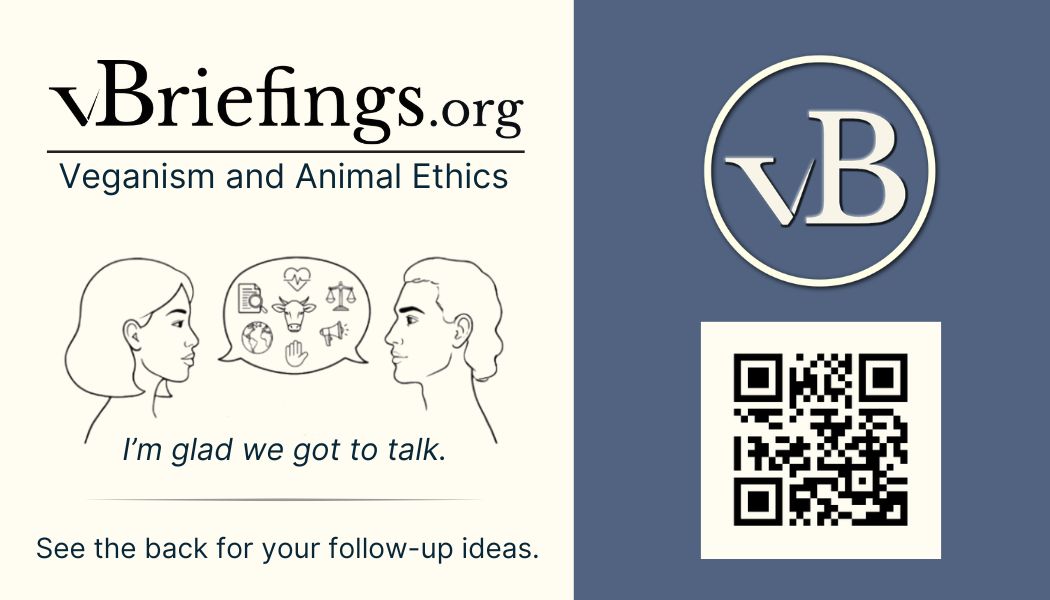
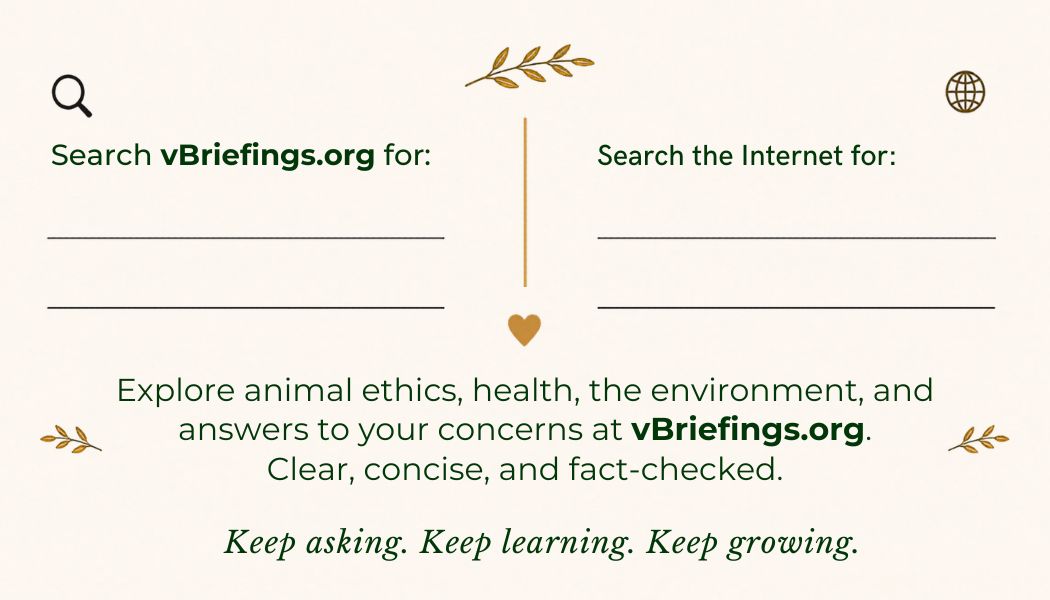
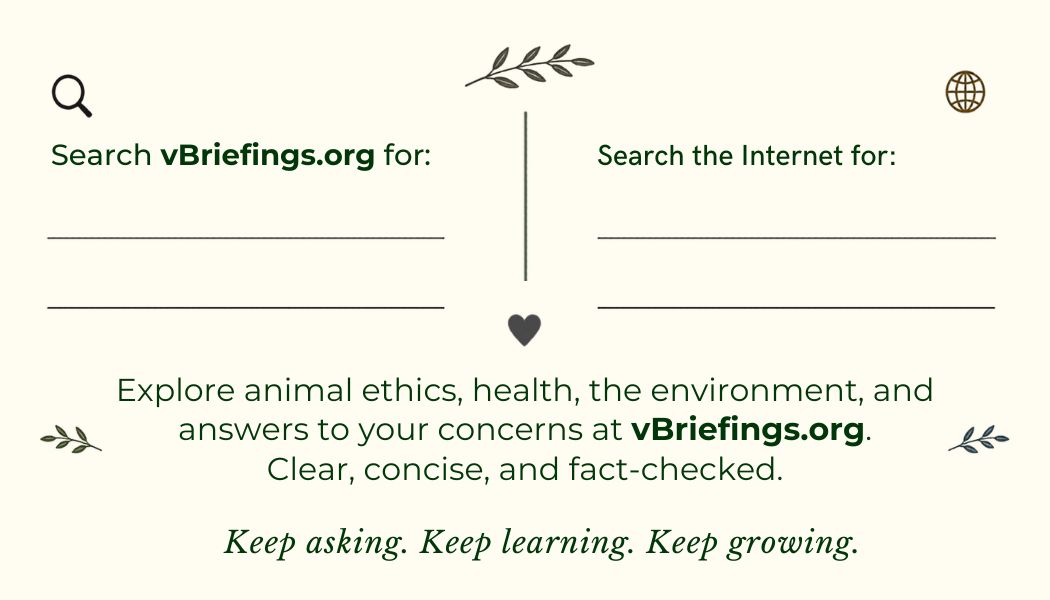
- If possible, provide an outreach card as a tangible reminder of the conversation and a way to offer follow-up recommendations tailored to the person’s interests, concerns, or objections.
- For details, see our briefing on Outreach Cards: Why They Work and How to Get and Use Them.
Exit the conversation on a high note.
First impressions matter, and so do last impressions. We suggest you close the conversation in three parts, usually in three brief sentences, delivered in a positive tone. The exact phrasing should depend on your relationship, the rapport you have established, and how receptive the person was during the conversation.
- Thank them for their time, their willingness to listen, or their openness to the conversation.
- Acknowledge something they said, a concern they raised, or a thoughtful part of the exchange.
- Express a hopeful expectation that points toward meaningful action.
By way of illustration, here are some sample wordings for varying circumstances. If some of these sound a little soft, remember that they assume that at this point in the conversation, you have already asked for a commitment and encouraged further follow-up.
- Stranger, brief conversation, somewhat receptive. “Thanks for taking the time to chat. I appreciated your point about convenience—it’s something a lot of people wrestle with. I think you’ll find some practical ways to start making choices that better reflect your own values.”
- Stranger, good rapport, quite receptive. “I really enjoyed our conversation. Your concern about treating animals fairly stood out to me. I can see you taking veganism seriously putting that concern into practice.”
- Friend or acquaintance, good rapport. “Thanks for hearing me out. I thought your point about consistency was especially important. I hope you’ll keep looking for ways to bring your choices more in line with your values.”
- A person who expressed concern for animals. “Thanks for the conversation. It’s clear that animals genuinely matter to you. I think that concern will keep moving you toward choices that respect them.”
- A person who took a small step. “I appreciate you taking the time to talk. I liked your willingness to consider practical changes rather than dismissing the issue. That sounds like a real first step toward living more consistently with your values.”
- Skeptical but engaged. “Thanks for the discussion. You asked good questions about whether change is realistic. I’m confident you’ll find that it is more doable than it may seem right now.”
- Close to a breakthrough. “I really appreciate the conversation. Your comments about not wanting to cause unnecessary harm stood out to me. Honestly, you sound like a pre-vegan who is already making the connection.”
- Younger person, enthusiastic. “Thanks for chatting with me. I loved how curious you were about all of this. I hope the curiosity will turn into meaningful change for the animals.”
- Longer conversation, strong rapport. I’m glad we had the chance to talk. Your thoughts about living according to your values really resonated with me. I think those values are going to keep pushing you toward meaningful change.”
- Playful conversation. “Thanks for putting up with me. [jokingly] You made it harder than most people do. I still think there’s a pre-vegan in there somewhere.”
- Very warm, highly receptive conversation. “Thank you for such a thoughtful conversation. I was especially encouraged by what you said about wanting your actions to match your values. I think you’re ready to start turning that concern into real change and be vegan”
- Already reducing animal products. “Thanks for taking the time to talk. I was encouraged to hear about the changes you’ve already made. It sounds like veganism is the next step.”
- Committed to veganism during the conversation. “Thank you for such a meaningful conversation. I was encouraged by your willingness to follow your convictions once you reached a conclusion. I’m excited for you as you begin putting those values into practice.”
Review each conversation and learn from it.
Each conversation becomes part of your preparation for the next one.
After each conversation, take a few moments to think and make notes about what happened. What worked well? What could have gone better? Were there questions you didn’t anticipate? Did you miss an opportunity to ask a better question or keep the focus on the animals?
Don’t judge yourself harshly. Even awkward conversations can help you improve. And remember that even if the conversation didn’t go as well as expected, you may have planted a seed that will grow.
- Quotes:
- “Vegans interested in teaching others should not necessarily be discouraged by an apparent lack of interest or gentle resistance but should provide enough information to plant a seed that may, after a period of dormancy, sprout into daylight.” B. MacDonald 8
- “Some people simply need time to think about an idea or to hear about it several times before they are ready to take it seriously.” Rachel MacNair, commenting on MacDonald’s quote.9
Counterclaims
Responses to some yes but retorts.
Counterclaims are usually not included in advocacy briefings because they don’t apply.
Supplementary Info
Additional information that may prove useful.
Potentially Useful Quotes
Here are some quotes that may come in handy in conversations because of their rhetorical punch and appeal to universal values.
| Quote | Attributed to |
| “Those who have the privilege to know have the duty to act.” | Often attributed to Albert Einstein; attribution disputed |
| “The question is not, Can they reason? nor, Can they talk? but, Can they suffer?” | Jeremy Bentham |
| “The unexamined life is not worth living.” | Socrates, in Plato’s Apology |
| “Injustice anywhere is a threat to justice everywhere.” | Martin Luther King Jr. |
| “The arc of the moral universe is long, but it bends toward justice.” | Martin Luther King Jr. / Theodore Parker |
| “It is not enough to be compassionate. You must act.” | 14th Dalai Lama |
| “The greatness of a nation and its moral progress can be judged by the way its animals are treated.” | Often attributed to Mahatma Gandhi; attribution disputed |
| “Each time a person stands up for an ideal, or acts to improve the lot of others, they send forth a tiny ripple of hope.” | Robert F. Kennedy |
| “Nonviolence is the greatest force at the disposal of humanity.” | Mahatma Gandhi |
Further Study
Sources providing a deeper understanding of the topic or related topics.
Other Resources
Note: These links do not constitute an endorsement. They are provided because some readers may find them useful.
- Debug Your Brain’s YouTube channel provides examples of conversations that encourage critical thinking and self-reflection.
- Faunalytics provides research, surveys, and analyses related to animal advocacy, public attitudes, and effective communication.
- Animal Think Tank provides free online training, workshops, and educational resources focused on effective communication, outreach, and advocacy for animals.
- The Center for Effective Vegan Advocacy provides research-based guidance on vegan outreach, behavior change, and advocacy effectiveness.
- The book Crucial Conversations by Kerry Patterson, Joseph Grenny, Ron McMillan, and Al Switzler provides strategies for discussing emotionally charged topics while maintaining respect and productive dialogue.
- The book How to Win Friends and Influence People by Dale Carnegie provides practical advice on building rapport, improving communication, and developing positive relationships.
- Street Epistemology International provides resources and examples of using respectful questions to help people examine the reliability of their beliefs.
- Anthony Magnabosco’s YouTube channel provides demonstrations of Street Epistemology conversations and effective question-based dialogue.
Advocacy Resources
Information to help with outreach and advocacy.
Share This Briefing
Cloned from the Preface Section on page load.
Companion Videos
Cloned from the Preface Section on page load.
Additional Visuals
How to use Additional Visuals
Feel free to share these visuals on social media or anywhere they might prove useful.
Click on an image to get an enlarged view, then right-click to save or copy to the clipboard. From an enlarged view, click on the ‘X’ in the upper right corner to exit the enlarged view and return to the visuals gallery.
Visuals Gallery
Presentation Slides
Click the link to view and optionally download the companion PowerPoint Slides for this briefing:
How to Use the Presentation Slides
Feel free to use and customize these slides for your own presentations. You can also mix this deck with slides from other briefings to build a custom presentation.
After clicking on the share link , you can view the slides and speaker notes. You can also download the PowerPoint file for editing and customization—just look for the download link. If you have a Microsoft account with OneDrive access, you can also save the slides to your personal onedrive.
Flash Cards
We partner with Brainscape for its excellent learning features. You will need to create a free Brainscape account to study the cards.
Go to Flash Cards: This will take you to a list of decks.
About Flash Cards and Brainscape
Flash cards are here to help you commit important facts and concepts in this briefing to memory.
In Brainscape, there is one deck for each briefing. You can study more than one deck at a time. Brainscape uses spaced repetition to promote memory retention. It is “the secret to learning more while studying less.”
You can study using your browser, but Brainscape also has a free mobile app that makes learning anywhere easy.
Outreach Cards +
See our briefing “Outreach Cards: Why They Work and How to Get and Use Them” for more information.
Also, we have other advocacy briefings on effective conversations, language, rapport, using the platform, and more.
Outreach cards are not specific to individual briefings, although they can be customized to direct people to a particular briefing. They are included here as a reminder that they are available and can be an effective follow-up tool for outreach.
Two designs are available: unbranded and branded.

Socratic Questions
Socratic-style questions are embedded in the Advocacy Notes below, and shown in italics.
These are open-ended, thought-provoking questions designed to encourage critical thinking, self-reflection, and deeper understanding. They are inspired by the Socratic method, a teaching technique attributed to the ancient Greek philosopher Socrates, who would ask his students probing questions rather than directly providing answers.
The goal is to help people examine their beliefs, clarify their thoughts, uncover assumptions, and explore the evidence and reasoning behind their ideas.
Advocacy Notes
Tips for Advocacy and Outreach
Briefings in the Advocacy Section of the knowledge base typically don’t offer tips because the entire briefing is about advocacy, and Socratic-style questions wouldn’t make sense here.
Footnotes
Our sources, with links back to where they are used.
- Wei, Yanqiu, Ling Zhang, Tao Lian, et al. “Happy Storytelling Promotes Emotional Contagion and Interpersonal Closeness.” Current Psychology 43, no. 4 (2024): 2993. https://doi.org/10.1007/s12144-023-04544-x [The authors note that intentional emotional contagion improves the overall efficiency of information processing and transmission between individuals.] ↩︎
- Consensus Report, People are More Receptive…, July 14, 2026. ↩︎
- Consensus Identity Resistance Report, 22 June 2025 ↩︎
- Palmer, Craig T. “Rape in Nonhuman Animal Species: Definitions, Evidence, and Implications.” Journal of Sex Research26, no. 3 (August 1989): 355–74. Accessed 2022-06-26 ↩︎
- Thompson, Helen. “Why Some Mammals Kill Babies of Their Own Kind.” Smithsonian, November 13, 2014. ↩︎
- Ritchie, Hannah. Dairy vs. plant-based milk: what are the environmental impacts? Our World in Data Research Group. January 19, 2022. ↩︎
- Cant, Meghann. “Bypassing Misinformation May Be As Effective As Correcting It.” Faunalytics, July 30, 2026, summarizing Calabrese, C., and D. Albarracín, “Bypassing Misinformation Without Confrontation Improves Policy Support as Much as Correcting It.” Scientific Reports 13 (2023): 6005. https://doi.org/10.1038/s41598-023-33299-5. ↩︎
- McDonald, B. (2000). “Once you know something, you can’t not know it”: An empirical look at becoming vegan. Society & Animals: Journal of Human-Animal Studies, 8(1), 1–23. https://doi.org/10.1163/156853000510961 ↩︎
- MacNair, Rachel M. “McDonald’s ‘Empirical Look at Becoming Vegan.’” Society & Animals 9, no. 1 (2001): 63–69. Archived full text. ↩︎