

Preface
Briefing description and more.
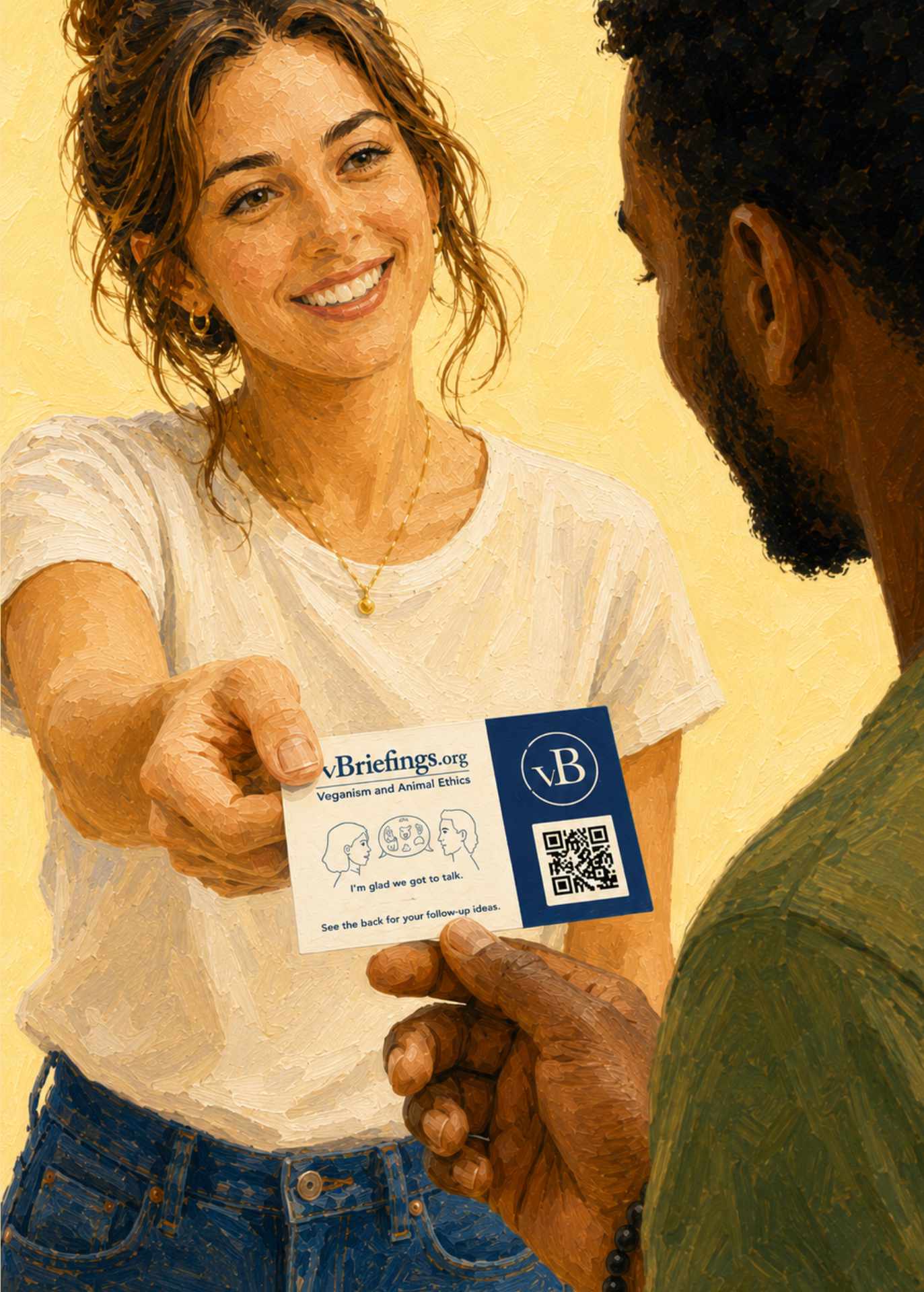
This briefing explains how to get and use outreach cards as personalized follow-up tools in vegan and animal rights conversations.
Companion Videos
Briefing Meta
Counts:
| Main Text | |
| Key Suggestions | 4 |
| Counterclaims | 0 |
| Supplementary | 2 |
| Further Study | 1 |
| Footnotes | 0 |
| Media & Advocacy | |
| Advocacy Notes | 0 |
| —Socratic Questions | 0 |
| Flashcards | 0 |
| Presentation Slides | 0 |
| Memes & Infographics | 0 |
| Companion Videos | 0 |
Activity Log:
Key Points Links
Loading…
Help Us Improve
Please send your suggestions for improvements, or report any issues with this briefing to [email protected]
We appreciate that you are taking the time to help us improve. All suggestions and reports will be carefully considered.
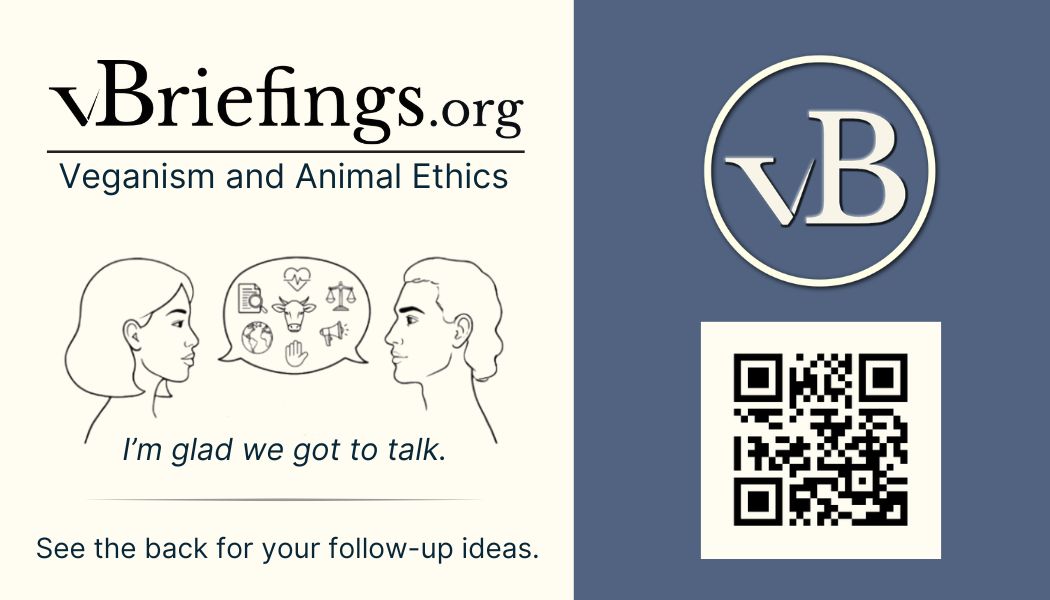
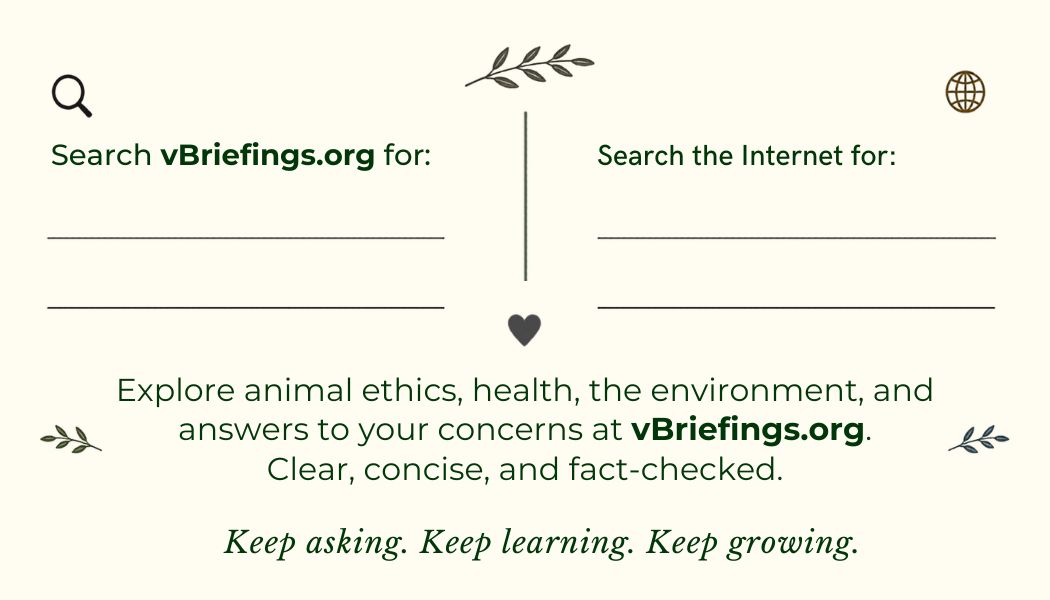
Two designs are available: unbranded and branded.

Summary
A concise summary of the briefing (see below for citations).
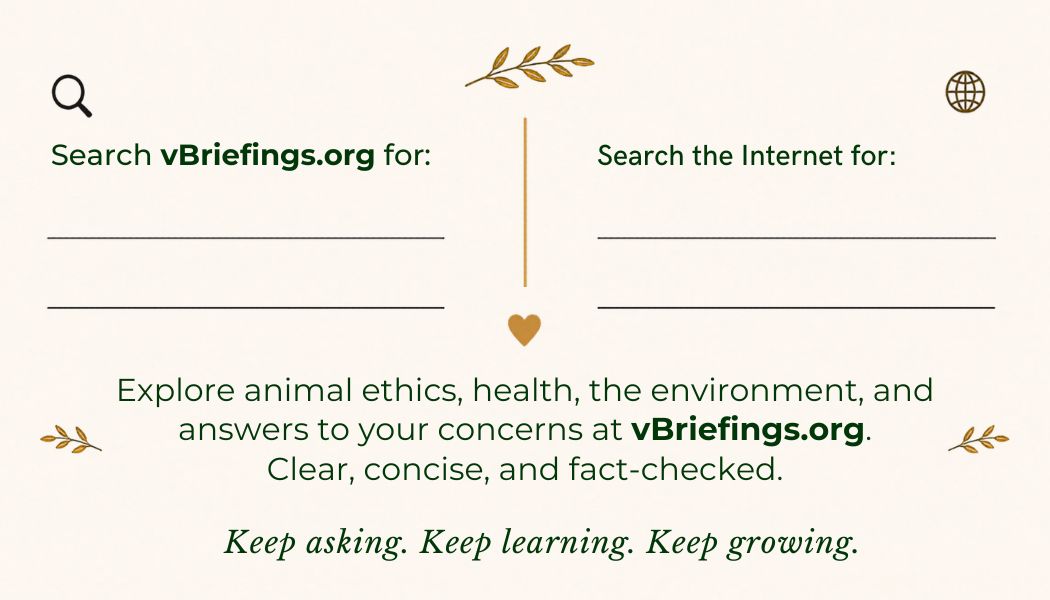
An outreach card is something you give out during or after a conversation about animal ethics or veganism to help the person remember the exchange and continue exploring after the conversation is over. The card has fill-in-the-blank areas to write suggestions for searches on vbriefings.org and on the web, providing a way for the advocate to direct the person to information matching their concerns.
The card is a standard business-card size. You could design your own, but we have two designs available to order from Canva. See the Supplementary Info section to see the designs and for information on how to get them.
The card works best when it is personalized. By pointing them to a topic, resource, film, briefing, or citation relating directly to the conversation, you give the person a practical next step. The personalization lets them know you’ve been listening to their concerns rather than just repeating talking points.
The card can also help you feel more confident to start or engage in a conversation. You do not have to remember every talking point or source before speaking. Say what you know and let the card point the person toward details they can look up later.
It’s a good idea to carry them at all times and customize them for each conversation. Remember that the card may help plant a seed even when the interaction didn’t seem very successful.
Note: See the real-world example in the Supplementary Info section, where a personalized card appears to have made a difference.
Context
Places this topic in its larger context.
Effective vegan and animal advocacy calls for more than one skill or tool. Rapport, Socratic questions, clear rhetoric, careful listening, and factual knowledge all matter. Outreach cards are one practical tool within that larger set.
Key Points
This section provides talking points.
Know Why and When to Use Outreach Cards
Outreach cards are specially designed business cards you can use during or after a conversation to direct people to web resources or to specific briefings on vbriefings.org. The card has fill-in-the-blank areas for writing suggestions for searches on vbriefings.org and on the web, providing a way for the advocate to direct the person to information matching their concerns. This makes it easier for them to follow up later.
You could just tell people where to follow up by mentioning a video, a briefing, or a website—but chances are they’ll forget after the conversation ends. Not necessarily because they don’t care, but because we all forget things that aren’t immediately written down or saved.
The card is a simple, tangible reminder—a bridge between the conversation you had and the information they may want to explore later. When you write a word or two on the back that ties to their interests or concerns, it lets them know you’ve been listening rather than just repeating talking points.
Outreach cards are helpful in a variety of settings:
- Casual conversations with friends or co-workers
- Chatting with waitstaff or baristas about vegan options
- Public outreach, tabling, or leafleting
- Events, conferences, or lectures
- Brief interactions where you only have a few moments to make a point
Keep the cards with you.
See the Supplementary Info section for information on how to get outreach cards.
Outreach cards are useful only when you have them at the moment a conversation happens. So keep them in your pocket, backpack, fanny pack, car, or wherever makes sense for your daily routine. That way, you are never in a situation where you need one and do not have it.
Because the cards are business-card size, carrying a few is easy, and it makes you better prepared when someone expresses curiosity about veganism, animal rights, plant-based eating, or a specific concern.
This is important: if you do not give people something to remind them of the conversation, they may never think about it again or pursue it further. The card greatly increases the chances they will explore further.
Let the card give you confidence and serve as your crutch.
An outreach card can make it easier to start or engage in a conversation because you do not have to feel fully prepared before you speak. You do not have to remember every talking point, source, citation, video, or briefing. Say what you know, answer as well as you can, and then use the card to point the person toward the details.
This is especially useful when you mention something specific, such as a study, article, film, or other resource. People are unlikely to remember pertinent details after the conversation ends. A personalized outreach card gives them a way to find it later and lets you stay focused on the conversation instead of trying to recite everything from memory.
The card can lower the pressure on you. Knowing that you have a simple follow-up tool in your pocket may make you more willing to seize an opportunity, ask a question, or respond when someone shows interest.
Note: vBriefings is very mobile-friendly, so feel free to bring up a briefing on your smartphone when appropriate to the circumstances.
Customize the card for each conversation.
Do not simply give the card and walk away. A card is more useful when it reflects the actual conversation you just had.
The fill-in sections “Search the Internet for…” and “Search vBriefings.org for…” make the card more personal and more practical. They also help the person remember what was discussed after the conversation ends.
And don’t forget to carry a pen. The fill-in sections only work if you can actually write on the card during or after the conversation.
The following table provides examples of how you might fill in the blanks for different scenarios.
Make the card personal and plant a seed.
The card should feel like a helpful resource, not a pressure tactic. A simple framing can work well:
- “Here’s a card that will help you find what we discussed and explore other topics you may be interested in. I wrote down the name of the movie I mentioned so you can find it with a simple search.”
- This shows respect for the person’s autonomy while still offering a practical next step.
The card can reinforce the idea that veganism is worth considering, that resources are available, and that you listened to their concerns.
Counterclaims
Responses to some yes but retorts.
Counterclaims are usually not included in advocacy briefings because they don’t apply.
Supplementary Info
Additional information that may prove useful.
Getting Outreach Cards
We have two designs available for ordering. One of the designs is unbranded with a motivational message on the front, while the other features vBriefings.org more predominantly.
The designs live on Canva.com, where you can order the cards using the links below. You will need to create a free Canva account to order if you don’t already have one. When you are logged in to Canva and click one of the links below, you will see a “Print With Canva” button in the top right corner. Follow that link to order.
Unbranded Design: (Canva Link)
Front of Card
Back of Card
Branded Design: (Canva Link)
Front of Card
Back of Card
Real-World Example
This story shows an actual experience by the author where an outreach card made a difference. It’s impossible to say exactly what part the card played in his change of behavior, but it seems likely it helped.
“I was picking up a to-go order of Tacu Tacu at a Peruvian eatery in Emeryville when the guy behind the register said, ‘I remember you. I haven’t eaten meat in eight days.’
“Then I recalled that over a week ago, when I was asking which items were vegan, he asked if I was vegan. So I answered yes and then asked if he was. He said no, so I asked him if he had ever considered it. He had, but he was concerned about protein because he was an athlete.
“After discussing protein, vegan athletes, and other related topics, I gave him an outreach card. I filled in the blanks on the back, directing him to search the website for “Protein” and search the Internet for “The Game Changers,” a movie about vegan athletes.”
Further Study
Sources providing a deeper understanding of the topic or related topics.
Other Resources
None Yet Listed
Advocacy Resources
Information to help with outreach and advocacy.
Share This Briefing
Cloned from the Preface Section on page load.
Companion Videos
Cloned from the Preface Section on page load.
Additional Visuals
How to use Additional Visuals
Feel free to share these visuals on social media or anywhere they might prove useful.
Click on an image to get an enlarged view, then right-click to save or copy to the clipboard. From an enlarged view, click on the ‘X’ in the upper right corner to exit the enlarged view and return to the visuals gallery.
Visuals Gallery
Presentation Slides
Click the link to view and optionally download the companion PowerPoint Slides for this briefing:
How to Use the Presentation Slides
Feel free to use and customize these slides for your own presentations. You can also mix this deck with slides from other briefings to build a custom presentation.
After clicking on the share link , you can view the slides and speaker notes. You can also download the PowerPoint file for editing and customization—just look for the download link. If you have a Microsoft account with OneDrive access, you can also save the slides to your personal onedrive.
Flash Cards
We partner with Brainscape for its excellent learning features. You will need to create a free Brainscape account to study the cards.
Go to Flash Cards: This will take you to a list of decks.
About Flash Cards and Brainscape
Flash cards are here to help you commit important facts and concepts in this briefing to memory.
In Brainscape, there is one deck for each briefing. You can study more than one deck at a time. Brainscape uses spaced repetition to promote memory retention. It is “the secret to learning more while studying less.”
You can study using your browser, but Brainscape also has a free mobile app that makes learning anywhere easy.
Outreach Cards +
See our briefing “Outreach Cards: Why They Work and How to Get and Use Them” for more information.
Also, we have other advocacy briefings on effective conversations, language, rapport, using the platform, and more.
Outreach cards are not specific to individual briefings, although they can be customized to direct people to a particular briefing. They are included here as a reminder that they are available and can be an effective follow-up tool for outreach.
Two designs are available: unbranded and branded.
Socratic Questions
Socratic-style questions are embedded in the Advocacy Notes below, and shown in italics.
These are open-ended, thought-provoking questions designed to encourage critical thinking, self-reflection, and deeper understanding. They are inspired by the Socratic method, a teaching technique attributed to the ancient Greek philosopher Socrates, who would ask his students probing questions rather than directly providing answers.
The goal is to help people examine their beliefs, clarify their thoughts, uncover assumptions, and explore the evidence and reasoning behind their ideas.
Advocacy Notes
Tips for Advocacy and Outreach
Briefings in the Advocacy Section of the knowledge base typically don’t offer tips because the entire briefing is about advocacy, and Socratic-style questions wouldn’t make sense here.
Footnotes
Our sources, with links back to where they are used.
Footnotes and Fact Check
There are no citations in this briefing because none are required under our evidence guidelines, which say that citations are not required for “statements written for an advocacy audience whose lack of a citation would reasonably indicate that they reflect the author’s experience, judgment, interpretation, or prior research.”
Just to make sure, we asked Consensus:
“Are there any factual claims made in this paper that are not true?” and the report stated, “No, this piece mostly gives advice rather than checkable factual claims, and none of its concrete claims are shown to be false in the text.”