

Preface
Briefing description and more.
This briefing provides practical guidelines for using certain often‑discussed and frequently debated words and terms of concern.
Companion Videos
Briefing Meta
Counts:
| Main Text | |
| Key Guidelines | 8 |
| Counterclaims | 0 |
| Supplementary | 2 |
| Further Study | 1 |
| Footnotes | 6 |
| Media & Advocacy | |
| Advocacy Notes | 0 |
| —Socratic Questions | 0 |
| Flashcards | 0 |
| Presentation Slides | 0 |
| Memes & Infographics | 0 |
| Companion Videos | 0 |
Activity Log:
Key Points Links
Loading…
Help Us Improve
Please send your suggestions for improvements, or report any issues with this briefing to [email protected]
We appreciate that you are taking the time to help us improve. All suggestions and reports will be carefully considered.
Partial List of Terms Covered
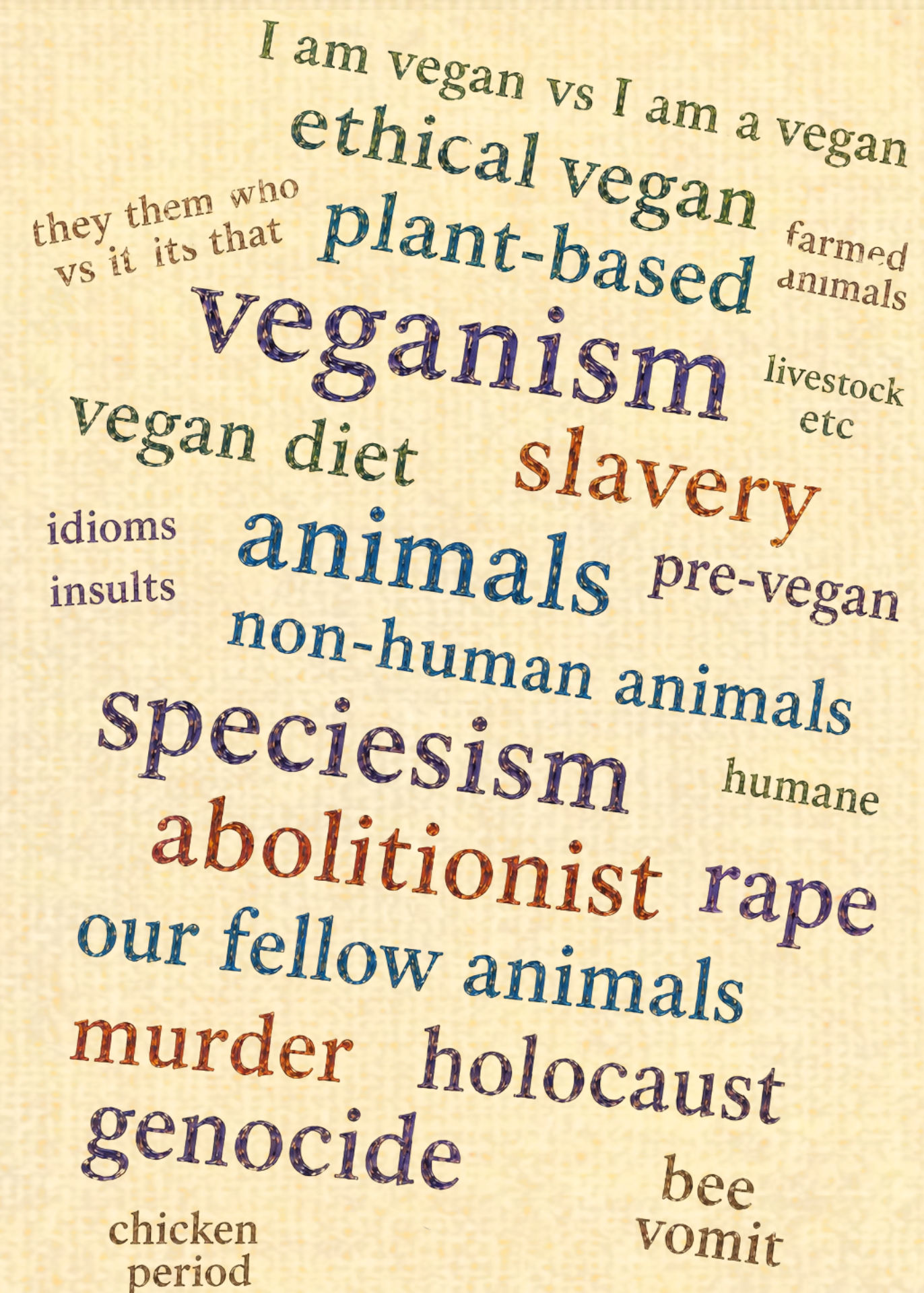
veganism • ethical vegan • plant-based • vegan diet • pre-vegan •• animals • farmed animals • non-human animals • other animals • our fellow animals • sentients • they them who vs it its that • slavery • genocide • holocaust • murder • abolutionist • speciesism • rape • chicken period • bee vomit • livestock etc • idioms • insults • humane
A Note on Disagreements and Policing
We don’t expect universal agreement with the recommendations in this briefing. Many involve judgment calls, and some remain the subject of ongoing debate.
Our goal is not to establish rigid rules or provide grounds for policing others, but to encourage thoughtful and hopefully useful consideration of our word choices.
Summary
A concise summary of the briefing (see below for citations).
Language shapes how we understand non-human animals, veganism, and the ethical issues connected to both. Effective advocacy language is accurate, audience-aware, and focused on the issue itself rather than on labels, identities, jargon, or emotionally charged terminology.
This briefing is designed to be broad enough to address many words and phrases of concern, yet concise enough to serve as a practical reference for conversations and advocacy. The aim isn’t to impose strict rules, but to encourage thoughtful communication that keeps the focus on the animals and the ethical issues at hand.
This briefing offers practical guidance on a wide range of word choices and explains the reasoning behind them. It covers how we refer to animals, describe veganism, use movement terminology, and approach sensitive comparisons.
Context
Places this topic in its larger context.
It’s widely recognized that the words we choose can shape perceptions, reinforce stereotypes, and quietly normalize harm toward others. This awareness leads careful communicators to make more intentional choices—avoiding language that defines disabled individuals by their limitations, rejecting racial terms with painful histories, and questioning phrases that dehumanize immigrants or marginalized communities.
In the same way, our choice of words shapes how society views non‑human animals. These same kinds of linguistic patterns can reinforce stereotypes and quietly justify exploitation.
Key Points
This section provides talking points.
Distinguish veganism from diets and partial practices.
Many vegan and vegan-adjacent terms are used inconsistently or imprecisely, which can create confusion. Some terms properly refer to veganism as an ethical way of living, while others describe dietary choices, products, or product categories. Using these terms carefully helps ensure that veganism is understood as an ethical commitment rather than merely a dietary preference.
Veganism
Use veganism to refer to an ethical position and way of living grounded in respect for animals and committed to avoiding participation in their exploitation. Veganism is not a diet, but a broader ethical commitment that applies across all areas of exploitation, including food, clothing, entertainment, sport, research, labor, and other human uses of animals.
Vegan
Use the word vegan to refer to:
- a person who has made an ethical commitment to refrain from participating in the use of animals in all relevant areas of life.
- a product that contains no animal ingredients, does not use products made from animals in processing, and is not tested on animals.
Although food is often the most visible part of vegan practice, veganism also extends to clothing, entertainment, sport, research, personal care products, household products, and other areas involving animals.
Because veganism is an ethical position rather than a diet, avoid using vegan as a synonym for plant-based or vegan diet. In popular usage, the term is often reduced to food choices alone, and advocates should avoid contributing to that confusion.
Some advocates avoid the word vegan because they believe it can be divisive or distracting. However, abandoning the term weakens the ethical meaning it conveys. A better approach is to use vegan clearly and consistently while explaining the concern for animals that underlies it when needed.
Ethical Vegan
The term ethical vegan is used to distinguish veganism rooted in concern for animals from diets adopted for health, environmental, religious, or other reasons.
Opinions differ on the advisability of using the term. Some have argued for its wider adoption because the word vegan has already been watered down in everyday usage and is often understood as referring primarily to diet. Others emphasize that ethical vegan is redundant because concern for animals is already central to veganism and argue that widespread use of the modifier may further weaken the meaning of the word vegan itself.
This is a gray area. Ethical vegan can help clarify meaning when the distinction is important, but some prefer to use vegan alone in order to preserve the connection between veganism and its ethical foundation. The best choice depends on the audience, context, and need for clarification, so use your best judgment.
We recommend using ethical vegan when it is important to make clear that a person embraces the full ethical meaning of vegan rather than any other intended meaning.
Vegan Diet
A vegan diet excludes all products made from animals, including meat, dairy, eggs, and other animal-derived ingredients. It also excludes foods that use products made from animals in processing.
A person who practices veganism necessarily eats a vegan diet, but a person who eats a vegan diet is not necessarily vegan. Someone may eat this way for health, environmental, religious, economic, or other reasons without adopting the broader ethical commitments of veganism.
Use vegan diet when the diet meets this strict definition and when discussing food specifically, such as nutrition, recipes, meal planning, or dietary change. Do not use vegan diet and veganism interchangeably, because doing so reinforces the misconception that veganism is primarily about food.
As explained below, and in most cases, the term plant-based diet is preferable to vegan diet because using the word vegan to name a dietary pattern blurs the distinction between a dietary pattern and an ethical practice.
Plant-Based and Plant-Based Diet
The term plant-based, when not followed by the word diet, can refer to a lifestyle choice, while plant-based diet describes a specific eating pattern. A plant-based diet might mean completely avoiding animal products, but it’s also often used to describe diets made mostly or primarily of plant foods. For instance, Kaiser Permanente defines it “as a regimen that encourages whole, plant-based foods and discourages meats, dairy products, and eggs as well as all refined and processed foods.1
The terms in no way imply an ethical position. They describe what a person eats, not why.
We recommend using plant-based and plant-based diet when referencing a lifestyle label or dietary pattern that lacks an ethical commitment to animals, even if the diet excludes all products made from animals. This helps preserve the distinction between veganism as an ethical practice and plant-based eating as a dietary pattern.
Pre-Vegan
Pre-vegan is sometimes used to describe a person who is not yet vegan but may be moving in that direction, or open to moving in that direction. The term is often intended to be encouraging and reflects the reality that some vegans pass through transitional stages before adopting veganism.
Some advocates use pre-vegan as a form of positive reinforcement. Similar to the assumptive technique used in sales, it frames veganism as a likely future outcome rather than a distant possibility. When used skillfully, it can help normalize the idea that becoming vegan is achievable and expected.
However, care should be taken when using the term. If sufficient rapport has not been established, some people may view it as presumptuous or as an attempt to define them in a way they have not chosen for themselves.
For these reasons, pre-vegan is best used thoughtfully and in contexts where it is likely to be received as encouragement rather than pressure.
Vegan-Friendly
Vegan-friendly describes products, restaurants, events, services, or other offerings that accommodate vegans or include vegan options, but its exact meaning is vague.
Some speculate that businesses use vegan-friendly for marketing because it can appeal to vegans while sounding less restrictive or less polarizing than vegan. There is rarely a need to use the term in conversation except when referring to how others use it.
Veganish
Avoid using veganish except when discussing the word itself. The term is vague, but usually describes a partial or flexible approach—being mostly vegan without fully committing. Adding -ish to the word vegan can make exploitation seem negotiable.
Introducing the word to an audience that may not have heard it could unintentionally help it spread. The most apt synonym is perhaps confused, but do not take that as a recommendation for using either word in conversation.
Flexitarian
Flexitarian describes a person who follows a mostly plant-based diet while intentionally allowing exceptions for animal products. Unlike veganism, the term is defined by flexibility rather than a commitment to avoid animal exploitation.
The word has obvious appeal because flexibility is generally viewed as a positive trait. In most contexts, being flexible is considered practical, adaptable, and reasonable. However, when applied to veganism, the term can blur the distinction between veganism and diets that continue to exploit animals.
For that reason, it is usually better to avoid repeating the word. A positive-sounding label may help normalize a concept that is ethically compromised.
Refer to animals thoughtfully, avoiding speciesist assumptions.
How we describe animals is central to effective advocacy. The terminology we choose can either recognize them as sentient individuals with intrinsic value or reduce them to mere objects and resources for human use.
In referring to non-human animals as a group, choose terminology thoughtfully according to context.
Choosing a collective term for non-human animals involves inherent trade-offs. Each of the terms discussed below has its own strengths and weaknesses. Selecting the most effective term requires careful consideration of the audience, context, and objective.
Farmed Animals
- When talking about animals raised for food on a farm, use the term farmed animals rather than farm animals. This emphasizes what is being done to them rather than implying that exploitation is just a natural part of who they are.
- Examples:
- Farmed animals are treated as property under the law.
- Most farmed animals are killed at a fraction of their natural lifespan.
Animals
- The term animals is simple and natural, but it can obscure the fact that humans are animals too and reinforce the mistaken idea that humans are separate from and above other animals.
- Use animals after you have already established that you are referring to non-human animals. Repeating non-human animals throughout a passage can become distracting, while using the word animals often improves readability.
- Example:
- Non-human animals are treated as property under the law, and animals raised for food are among the most affected.
Our Fellow Animals
- The phrase our fellow animals emphasizes that humans are animals too and highlights our kinship with other animals. Unlike terms such as non-human animals or other animals, it explicitly reminds us that we are members of the same broader community of living beings.
- Because the phrase carries emotional and relational elements, it is best used selectively. Overuse can make the wording sound advocacy-oriented.
- Use our fellow animals when the goal is to emphasize connection, shared experience, or moral consideration.
- Examples:
- The treatment of our fellow animals says much about our values.
- Like us, our fellow animals seek comfort, avoid pain, and value their own lives.
Non-Human Animals
- The term non-human animals makes it clear that humans are animals too. However, it can sound technical or cumbersome when repeated frequently.
- Use this term when you want to be explicit or when greater precision is needed.
- Example:
- Non-human animals are used in research and agriculture.
Other Animals
- The term other animals includes humans within the broader category of animals and often sounds more conversational than non-human animals. However, some may find it unfamiliar or unclear, particularly if the comparison to humans is not explicit.
- Use other animals when the human-animal comparison is clear from the context.
- Good examples:
- Just as we do not judge humans’ worth by intelligence, we should not do so for other animals.
- Our relationship with other animals is shaped by culture.
- Less clear:
- Other animals are used in research and agriculture.
- When a sentence begins this way, the reader may experience a brief cognitive hitch, looking backward for a missing referent—asking, “Other than which animals?”
- Other animals are used in research and agriculture.
Sentient Beings
- The term sentient beings highlights an animal’s capacity for subjective experiences, like pain and pleasure. However, the phrase can sometimes feel academic, which risks disconnecting audiences from individual animals.
- Use this term when your goal is to emphasize the ability to suffer or have subjective experiences.
- Example:
- These policies affect sentient beings who can experience pain.
Sentients
- Sentients is shorthand for sentient beings. Because it is unfamiliar to many and can sound jargon-like, it is best used sparingly, if at all.
- The term may be appropriate when writing for audiences already familiar with animal advocacy concepts. In spoken conversation, it may also be confused with the word sentience, as they sound the same or similar.
- Example
- How we treat sentients is a reflection of our values.
- When spoken, this could come across as “How we treat sentience is a reflection of our values.”
- How we treat sentients is a reflection of our values.
In referring to individual animals, use words that recognize them as individuals rather than objects.
The words we use when referring to an individual animal shape how we think about them. Our language can either reduce them to objects or recognize them as individuals with their own lives and experiences.
Use appropriate pronouns. Use personal pronouns. Refer to sentient individuals using they, them, and who rather than it, its, or that. While it and that reduce an individual to an object, personal pronouns acknowledge them as being someone, not something.
- Good Examples:
- The pig was injured, so they struggled to stand.
- A cow who was separated from her calf…
- Bad Examples:
- The pig was injured, so it struggled to stand.
- A cow that was separated from its calf…
Use names when known and relevant. Names reinforce individuality and foster genuine emotional connection. However, avoid naming arbitrarily or sentimentally when doing so might be perceived as manipulative. In such cases, refer to the individual by species or descriptive language.
- Effective Examples:
- Bella was rescued from a dairy farm. (Appropriate use of a known individual’s name.)
- Rosie enjoys spending time with her companion Lucy. (Appropriate; names underscore a specific, observed relationship.)
- Manipulative or Arbitrary Example:
- Every day, a mother cow—let’s call her Daisy—has her calf taken away. (Arbitrary; invents a fictional name for a systemic issue to force an emotional reaction.)
Don’t let grammar tools override your intent.
- Style software like Grammarly may flag they, them, and who when referring to individual animals and suggest replacing them with it, its, or that. Ignore these suggestions. Our goal is not adherence to traditional convention, but language that recognizes animals as sentient individuals rather than objects.
Tread carefully with sensitive analogies.
Note: Specific techniques for mitigating sensitive reactions will be presented in our forthcoming briefing on Effective Conversations.
Comparisons involving sensitive concepts such as slavery, the Holocaust, or rape can generate strong reactions because of their historical, cultural, personal, or political weight. Advocates may use these analogies to highlight the seriousness of animal exploitation, but they can also backfire by shifting attention away from animals and toward debates over definitions, history, or the speaker’s intentions.
A word can be factually defensible and still be a strategic mistake. The real test is whether the term helps people understand the ethical issue or creates a barrier to understanding.
In many contexts, plain, direct language about what animals experience will be more effective than sensitive analogies. In some cases, however, a careful analogy can help people recognize shared patterns of domination, exploitation, or oppression. The examples below discuss several terms individually, followed by techniques that may reduce negative reactions when such comparisons are used.
The goal is not to avoid difficult ideas, but to communicate them in ways that keep the focus where it belongs: on the animals. Readers may disagree about particular words or boundaries, but the aim is thoughtful judgment, not rigid uniformity.
In the discussion that follows, each analogous term is considered separately and includes our recommendations. The most important principle is simple: if a comparison is going to be used, help the listener see why it is apt before, or at the moment, the sensitive word is introduced.
One way to cool emotional reactions that may arise during a conversation is to clarify that you are comparing, not equating.
Slavery and Animal Slavery
The comparison of human slavery to the similar treatment of animals is sensitive because it can be viewed as disrespectful, offensive, or as minimizing the suffering of enslaved peoples. It can also be a reminder of demeaning comparisons of minorities to animals.
The comparison has validity where the characteristics are similar: ownership, confinement, forced labor, reproductive control, family separation, buying and selling individuals, and treatment as property. The comparison is not w humans and other animals, but between types of oppression.
Whether the comparison is effective depends heavily on the audience, setting, and purpose of the conversation. Even when the similarities are explained first, the word slavery may still provoke a strong emotional reaction. In some cases, using the term animal slavery can help mitigate this reaction by making clear that we are not referencing human slavery, but it can also result in a dismissal of the similarities.
Helping people understand the relevant similarities before introducing the term can make them more receptive to considering the comparison on its merits. For that reason, advocates should use the term with care and thoughtful judgment.
Holocaust and Animal Holocaust
Comparisons of mass animal slaughter to the Holocaust are sensitive because they can be seen as insulting, disrespectful, offensive, or as minimizing the suffering of Holocaust victims and survivors.
While there are similarities in characteristics such as large-scale confinement, transportation, family separation, deprivation, and industrialized killing, we generally recommend against using the term Holocaust in advocacy conversations. This is because reactions are often intense because the term is widely understood as referring to a particular horrific event that is still fresh in our collective memory.
In some cases, using the term animal holocaust can help mitigate this reaction by making clear that we are not referencing a particular historical event, but it can also result in a dismissal of the similarities. Even when prepending the word animal, advocates should use the term with extreme care and thoughtful judgment.
When referring to pig slaughter, consider working in the phrase gas chamber as an alternative to holocaust. This makes the association indirectly.
Genocide
Comparisons to genocide are sensitive because, although the word generally refers to the deliberate annihilation of a group, for some is associated with a particular event they may have an emotional connection to. Another reason its application to animals may be challenged is that the word was coined to describe atrocities against human groups, as indicated by the root gen, meaning people or group.
Advocates typically use the term to describe organized, large-scale killing of animals, including slaughterhouse killing, the culling of male chicks, and mass killing after disease outbreaks or natural disasters. Use it thoughtfully, and not in ways that shift attention away from animals and toward the word itself.
Concentration Camp, Animal Concentration Camp
The term concentration camp predates the Holocaust and historically refers to places where large numbers of people are confined, often without normal legal protections. Nevertheless, the term is strongly associated with Nazi concentration camps and the Holocaust in people’s minds.
As a result, its use can provoke reactions similar to those associated with Holocaust comparisons. This can be mitigated by modifying the term to animal concentration camp.
The comparison may seem especially apt in the context of factory farming, where large numbers of animals are concentrated in confined spaces. Indeed, the term concentration camp bears some resemblance to CAFO (Concentrated Animal Feeding Operation), the industry term for large-scale industrial animal production.
Whether the comparison is effective depends on the audience and context. Advocates who use the term should be prepared for strong reactions and should ensure that the similarities they wish to highlight are understood.
Abolition, Prison Abolition, and Abolitionist
Within the animal advocacy movement, abolitionist is a well-established and appropriate term for a specific position: seeking the end of animal exploitation rather than merely improving welfare standards. In that context, there is generally no reason to avoid the term. Others outside the movement may simply be unfamiliar with the specialized meaning the terms have acquired within animal advocacy.
The terms can be sensitive outside the movement because many people associate abolition and abolitionist primarily with the abolition of human slavery. For some, using the words in an animal advocacy context can seem inappropriate, offensive, or as minimizing the significance of the historical abolitionist movement. One way to reduce that reaction is to use the term to prison abolition, which provides some separation from slavery abolition.
The word has force in both a historical and animal ethics context because it calls for rejecting exploitation rather than reforming it. As with other words, it is helpful to explain the intended meaning and the relevant similarities when using them in advocacy conversations.
Murder
Dictionary and legal definitions of murder typically limit the term to the unlawful killing of a human being. But despite any definitional or legal objections, relating the term to non-human animals is usually understood immediately. The comparison has force because it asks whether the intentional killing of sentient beings can be justified simply because the victims belong to a different species.
Unlike terms such as Holocaust or slavery, murder does not usually invoke a particular historical event or group. However, it can still create defensiveness, especially when directed at a person’s own actions or choices. For that reason, the term may be more effective in slogans, signs, literature, or other contexts where its purpose is to challenge assumptions. In conversation, particularly when used in an accusatory manner, it can quickly shift attention away from the ethical concern and toward the word itself. Advocates should therefore use the term thoughtfully and with awareness of how it is likely to be received.
Rape
The word rape carries strong emotional weight. For people who have experienced sexual violence or know someone who has, applying the term to other animals can be taken as offensive, insensitive, or as minimizing the experiences of human victims. The reaction may be especially strong because the comparison is accusing them of being complicit in rape. A highly emotional reaction can shut down the conversation.
The practices we are referencing include forcible insemination despite resistance and without consent, and to the collection of semen, where forced mounting and electro-ejaculation are used. Both of these are covered in more detail in our briefing on cow injustices.
In the face of a strong emotional reaction, you might ask, “If the word bothers you that much, shouldn’t you be bothered even more by the action? Shouldn’t that cause you to think about the victims?”
One way to get the point across without using the word is to ask, after describing a practice, “If this were done to a human, what would you call it?”
Whether the comparison is effective depends on the audience and the setting. Caution is advised in using the term in advocacy conversations.
Chicken Period
We recommend against referring to eggs as chicken periods because the comparison is technically incorrect, and even if it were correct, it does not invoke the intended disgust. A chicken’s egg is an ovum, not menstrual tissue, and chickens do not menstruate in the way humans do.
The phrase relies on disgust rather than ethical reasoning. Also, the phrase can come across as juvenile or manipulative rather than persuasive.
It is more effective to focus on the realities of egg production, such as selective breeding, confinement, reproductive exploitation, the maceration or suffocation of male chicks, and the slaughter of laying hens when their reproductive organs are exhausted and they are no longer profitable.
Bee Vomit
As with chicken periods, we recommend against referring to honey as bee vomit. The phrase fails to invoke the intended disgust, and it is biologically imprecise.
Honey production involves regurgitation, but it is not simply vomiting in the ordinary sense. Bees collect nectar, store it in a specialized honey stomach, enzymatically modify it, transfer it among bees, and deposit it into the honeycomb.
People are more likely to find the comparison disingenuous than to feel disgust for a product they may find delicious. It is more effective to focus on the realities of honey production and bee exploitation than to use a label that listeners may dismiss as inaccurate or manipulative.
Use ideological labels judiciously.
Many terms used within vegan and animal advocacy are labels for broader concepts. Terms such as speciesism, abolitionist, animal liberation, ethics of care, and related words can be especially useful for audiences familiar with them.
In advocacy conversations, however, unfamiliar terms can become the focus instead of the ethical concern. Assess the audience and, when needed, explain the idea before using the label. Once understood, these terms can become powerful tools.
Lead with the animals or the ethical concern. Introduce movement terminology and ideological labels when they add clarity and contribute to the cause.
Abolitionist
To those within the movement, an abolitionist refers to those of us working for the end of exploitation rather than better welfare standards. There are those unfamiliar with both animal ethics and history who may not recognize the word at all. Still, the word abolition is a potential trigger word for some who do know the history.
Animal Liberation
Animal liberation can be powerful because it frames the issue as freedom from domination and exploitation, not merely better treatment. However, audiences outside the movement may hear the phrase literally and imagine farmed animals being released into the wild. When using the term, clarify the kind of freedom being discussed.
Speciesism
Speciesism is especially useful because many people recognize its relationship to other forms of discrimination. It can help connect animal ethics to broader concerns about prejudice, exclusion, and unequal moral consideration. Some audiences will understand it quickly on first exposure as anotherism based on discrimination; others may need the idea explained.
Ethical Frameworks
Ethical frameworks such as rights, utilitarianism, virtue ethics, and ethics of care, along with terms such as deontological and consequentialist, can be useful with audiences already familiar with them. They can create rapport through shared concepts and help clarify the reasoning behind animal ethics. With unfamiliar audiences, however, they may sound obscure or academic. In those settings, explain the practical ethical concern before introducing the framework.
Don’t obscure animals’ individuality or treatment.
Words are often used to sanitize violence and obscure the individuality of animals. When describing animals and the practices that affect them, use terms that are literal, accurate, and individual‑first whenever this can be done without awkwardness.
Some of the terms listed below are so widely used in laws, regulations, research papers, news reports, and industry publications that avoiding them may be impractical. In these situations, it may be appropriate to use the questionable term, especially if it is more precise or concise than the alternatives. There is often a tradeoff between clear communication and avoiding compromising language. As always, judgment is required.
| Avoid | Alternatives | Why |
| farm (in the context of animal farming) | animal factory | Research shows an even stronger negative reaction than “factory farm.”2 |
| livestock, stock, herd, heads, units | farmed animals, cows, sheep, individuals | Avoids framing animals as economic assets. |
| beef, pork, poultry | cow flesh, pig meat, bird meat (or name the specific animal) | Connects the consumer product directly back to the individual who was killed for it. |
| broiler, layer, breeder | chicken raised for meat, hen exploited for eggs, animal used for breeding | Defines animals entirely by their industrial role and obscures their individuality and exploitation. |
| seafood, fish (as a mass noun) | marine life, fishes, sea individuals | Pluralizing fishes highlights individual lives rather than a collective resource. |
| milk, cow milk | cow’s milk | Indicates that the milk comes from cows and belongs to them, and avoids treating cow’s milk as the default. |
| meat, dairy, and eggs | flesh and secretions | We recommend using this alternative it sparingly and not repeatedly since it can distract from ethical concerns. |
| crop, yield, production unit | population, number of individuals | Rejects language that equates living populations to plant agriculture or factory outputs. |
| producer, grower | exploiter, owner, business | Avoids industry public relations framing that portrays animal exploitation as neutral “production.” |
| byproducts, co-products | animal body parts, slaughterhouse waste, derived substances | Rejects industry efficiency framing that sanitizes the origin of materials like leather, gelatin, or fat. |
| pet, pet owner | companion animal, guardian, caregiver | Emphasizes relationship rather than possession. |
| racehorse, laboratory animal, circus animal | horse forced to race, animal abused for research, animal exploited in entertainment | Shifts the focus from a defined “type” of animal to the specific human exploitation being forced upon them. |
| spent (e.g., “spent hen”, “spent dairy cow”) | exhausted, physically depleted, aged | Rejects that an animal’s worth depends on their capability to reproduce. |
| processing, harvesting, culling, depopulate, depopulation | slaughtering, killing, mass extermination, suffocation, maceration, gassing | Replaces euphemisms with words that describe the physical reality |
| euthanasia (in an industrial context) | slaughter, killing | Euthanasia implies an act of mercy for the individual’s benefit instead of for profit, population management, or convenience. |
Replace harmful idioms.
Many common idioms use animals as symbols of violence, domination, or disposability, reinforcing the idea that harming animals is acceptable. Choose innocuous alternatives or avoid the idioms entirely and state your meaning directly.
Examples
| Common Idiom | Suggested Replacement |
| Kill two birds with one stone. | Feed two birds with one scone. |
| Beat a dead horse. | Feed a fed horse. |
| Bring home the bacon. | Bring home the bagels. |
| Be the guinea pig. | Be the test tube. |
| Take the bull by the horns. | Take the flower by the thorns. |
| More than one way to skin a cat. | More than one way to peel a potato. |
| Put all your eggs in one basket. | Put all your berries in one bowl. |
| Hold your horses. | Hold your phone. |
| Open a can of worms. | Open Pandora’s box. |
| Packed like sardines. | Packed like pickles. |
| Wild goose chase. | Out chasing rainbows. |
- Let Positive Comparisons Stand. Expressions like strong as an ox, busy as a bee, or eagle-eyed generally do not carry speciesist implications because they express admiration rather than contempt. While these phrases still use animals to symbolize human traits, they do not demean them or portray them as inferior. They are acceptable to use, provided they are grounded in reality rather than harmful stereotypes.
Avoid using animals as insults.
Language often uses animals as shorthand for undesirable human characteristics. People may be called pigs, rats, snakes, apes, jackasses, cows, or dogs to suggest that they are dirty, dishonest, unintelligent, aggressive, unattractive, or otherwise inferior. Such language reinforces speciesist attitudes by treating animals as symbols of negative traits rather than as individuals with their own lives, interests, and capacities.
| Avoid | Possible Alternative |
| He’s a pig. | He’s messy. |
| She’s a cow. | [Avoid comments about body size except when appropriate, respectful, and necessary.] |
| He’s a rat. | He betrayed someone’s trust. |
| She’s a snake. | She’s deceptive or manipulative. |
| Don’t be an ape. | Don’t be reckless, destructive, or immature. |
| He’s a jackass. | He’s acting foolishly. |
| He’s an animal. | He’s acting violently, cruelly, or aggressively. |
Some animal-based insults, especially cow and sometimes pig, are used to criticize body size. In general, avoid comments about another person’s body size unless the discussion is appropriate, respectful, and necessary.
Don’t promote humane-washing through language.
- Humane-sounding labels and certifications should be avoided except when explaining or debunking humane-washing. These include phrases like cage-free, free-range, Certified Humane, and similar claims. Such language can create the impression that animals were treated well, without describing what they actually experienced. Here is some supporting context:
- Humane labels and certifications are a form of humane-washing, deceiving consumers by portraying animal products as ethical while hiding the reality of suffering. Investigations by Consumer Reports and the Open Philanthropy Project found that terms such as cage-free, free-range, and pasture-raised are largely meaningless, with audits that are infrequent, ineffective, and rarely enforced.345
- Even the highest-tier certifications allow for extreme confinement, lack of exercise and socialization, genetic modifications that cause health issues, and routine practices such as separating calves from their mothers and mass-killing male chicks.6
Counterclaims
Responses to some yes but retorts.
Counterclaims are usually not included in advocacy briefings because they don’t apply.
Supplementary Info
Additional information that may prove useful.
More on Movement Disagreement
Some terms may be controversial because of their association with particular activists, campaigns, organizations, philosophies, or schools of thought within animal advocacy. We are not listing those terms here because doing so would add little value to this, a practical guide.
Advocates may also object to terms they associate with approaches they reject. The point is not to settle those disagreements here, but to recognize that language can carry movement-specific baggage.
Species-Based Double Standards in Language
Language often reflects inconsistent attitudes toward different species. Dogs and cats are frequently described as companions, friends, or family members, while pigs, cows, chickens, and fish are more often described as food, livestock, products, or resources. These differences illustrate how language can both reflect and reinforce species-based assumptions.
Further Study
Sources providing a deeper understanding of the topic or related topics.
Other Resources
None yet.
Advocacy Resources
Information to help with outreach and advocacy.
Share This Briefing
Cloned from the Preface Section on page load.
Companion Videos
Cloned from the Preface Section on page load.
Additional Visuals
How to use Additional Visuals
Feel free to share these visuals on social media or anywhere they might prove useful.
Click on an image to get an enlarged view, then right-click to save or copy to the clipboard. From an enlarged view, click on the ‘X’ in the upper right corner to exit the enlarged view and return to the visuals gallery.
Visuals Gallery
Presentation Slides
Click the link to view and optionally download the companion PowerPoint Slides for this briefing:
How to Use the Presentation Slides
Feel free to use and customize these slides for your own presentations. You can also mix this deck with slides from other briefings to build a custom presentation.
After clicking on the share link , you can view the slides and speaker notes. You can also download the PowerPoint file for editing and customization—just look for the download link. If you have a Microsoft account with OneDrive access, you can also save the slides to your personal onedrive.
Flash Cards
We partner with Brainscape for its excellent learning features. You will need to create a free Brainscape account to study the cards.
Go to Flash Cards: This will take you to a list of decks.
About Flash Cards and Brainscape
Flash cards are here to help you commit important facts and concepts in this briefing to memory.
In Brainscape, there is one deck for each briefing. You can study more than one deck at a time. Brainscape uses spaced repetition to promote memory retention. It is “the secret to learning more while studying less.”
You can study using your browser, but Brainscape also has a free mobile app that makes learning anywhere easy.
Socratic Questions
Socratic-style questions are embedded in the Advocacy Notes below, and shown in italics.
These are open-ended, thought-provoking questions designed to encourage critical thinking, self-reflection, and deeper understanding. They are inspired by the Socratic method, a teaching technique attributed to the ancient Greek philosopher Socrates, who would ask his students probing questions rather than directly providing answers.
The goal is to help people examine their beliefs, clarify their thoughts, uncover assumptions, and explore the evidence and reasoning behind their ideas.
Advocacy Notes
Tips for Advocacy and Outreach
Briefings in the Advocacy Section of the knowledge base typically don’t offer tips because the entire briefing is about advocacy, and Socratic-style questions wouldn’t make sense here.
Footnotes
Our sources, with links back to where they are used.
Note on Consensus Research Reviews
We sometimes provide a Consensus AI research review in addition to, or in place of, traditional citations. These reviews analyze relevant academic literature, summarize the findings, and provide references to the underlying studies. This approach allows readers to see the broader state of the evidence without having to locate, read, and interpret numerous research papers themselves.
- Phillip J Tuso, MD, Mohamed H Ismail, MD, Benjamin P Ha, MD, and Carole Bartolotto, MD, RD. “Nutritional Update for Physicians: Plant-Based Diets.” The Permanente Journal – The Permanente Press – Kaiser Permanente – Permanente Medical Groups, 2013. ↩︎
- Erika Berglund, Carol Hardy, and Allison Troy, Animal Factory, Factory Farm, Or Something Else? Testing the Language of Advocacy (Faunalytics, July 29, 2026), https://faunalytics.org/animal-factory-factory-farm-or-something-else. ↩︎
- “The Dirt on Humanewashing | Publications.” Farm Forward, 13 Dec. 2020. ↩︎
- Investigations were carried out in 2016 by Consumer Reports and published on various pages of their greenchoices.org website. These pages have since been removed, but can be reached from this archive link. ↩︎
- “Global Animal Partnership — General Support (2016) | Open Philanthropy.” Open Philanthropy, 30 July 2024, www.openphilanthropy.org/grants/global-animal-partnership-general-support-2016/. Accessed 28 Aug. 2024. ↩︎
- “The Dirt on Humanewashing | Publications.” Farm Forward, 13 Dec. 2020. ↩︎