

Briefing Title, Slug, and Excerpt
If you are authoring a briefing, many of these elements will likely be given to you, and they may change before publication. Even if they’re later changed, it’s handy to have “working” versions of these.
The Briefing Title
The title of a briefing is of central importance due to its high visibility and its role as the reader’s first point of contact with the content. It should immediately communicate what the briefing covers and allow the reader to understand, at a glance, whether the topic is relevant to their interests or needs.
Titles should be treated as working titles throughout the drafting process. As the structure and emphasis of the briefing evolve, the title may need to be refined to more accurately reflect the final content. It is not uncommon for a title to change as the draft develops and the scope becomes clearer.
The title should:
- …be accurate, concise, and descriptive. They should clearly convey the subject and, where appropriate, the framing or conclusion of the briefing. Avoid sensational, hyperbolic, or clickbait language. The goal is clarity and credibility, not persuasion through wording. A reader should feel confident that the title faithfully represents the content of the briefing.
- …use natural, readable phrasing rather than keyword-driven constructions. They should be easy to understand when read quickly and should not require interpretation or prior context. Prefer straightforward language over cleverness or wordplay.
- …be considered in relation to the broader set of briefings. They should fit naturally within existing naming patterns and contribute to a coherent, well-organized system. Over time, this consistency allows users to better understand the structure of the knowledge base and more easily navigate between related topics.
Length
Titles should be long enough to clearly convey the subject and scope of the briefing, but no longer than necessary. In practice, most effective titles fall within a moderate range—often between roughly 6 and 14 words—depending on the complexity of the topic.
Shorter titles are appropriate when the subject is simple and widely understood, such as The Environmental Impact of Animal Agriculture. Longer titles are appropriate when additional phrasing is needed to clarify the claim or scope, such as A Vegan Diet Supports Good Health and Reduces Chronic Disease Risk. In these cases, clarity should take precedence over strict brevity.
Avoid titles that are so short that they become vague or ambiguous, as well as titles that are unnecessarily long or burdened with multiple clauses. If a title begins to feel like a sentence rather than a concise label, it should be tightened. The goal is a title that can be quickly read and easily understood while still conveying the essential focus of the briefing.
Also avoid long titles that don’t fit well on the Social Image for the briefing.
Title Patterns
Many effective titles follow a pattern in which a general topic is paired with a clarifying phrase. For example, Veganism 101: An Introduction and Plant Protein: Abundant, Complete, and Healthier both use a main subject followed by a concise description of what the briefing will cover. This structure is especially useful for introductory, explanatory, or thematic briefings.
Titles may also take the form of a direct statement or claim, particularly when the purpose of the briefing is to present or support a specific conclusion. For example, A Vegan Diet Supports Good Health and Reduces Chronic Disease Risk clearly communicates the central claim of the briefing. This approach is appropriate for health, environmental, and other evidence-based topics where the conclusion is well supported.
For briefings focused on specific animals, titles often follow a consistent pairing structure, such as [Animal] Injustices and Suffering and [Animal] Sentience and Cognition. This consistency helps reinforce the organization of the knowledge base and allows readers to easily locate related material across different species.
Special Considerations for Objection Section Titles
For briefings in the Objections Section, titles are often enclosed in quotation marks to indicate that an objection is being expressed rather than endorsed. This signals to the reader that the briefing will analyze and respond to a commonly stated claim.
Examples include:
- “Eating Vegan Is Too Expensive”
- “One Person is Powerless to Make a Difference”
- “Vegans Kill More Because of Crop Deaths”
- “Plants Are Sentient and Have Feelings Too”
When using quoted titles, the wording should reflect how the objection is commonly expressed in real conversations. The phrasing should feel natural and recognizable, even if it is not perfectly precise. This helps ensure that the briefing connects with the way the issue is actually encountered in discussion.
In some cases, a briefing may address an objection while also serving as a broader informational resource. In such cases, a non-quoted title may be used if it better reflects the overall scope of the content.
The Briefing Slug
What is a Slug?
Every briefing is assigned a unique slug, which is the last segment of its URL. For example, the slug for the briefing “Vegans Kill More Because of Crop Deaths” is “/kill”. This means the full briefing URL is vbriefings.org/kill.
Unique Single “Guessable” Word
Slugs must be unique, so it’s a good idea to think ahead for possible briefings to avoid future conflicts, especially when you expect multiple briefings on closely related topics.
Slugs will normally be the single word that best represents the briefing. As such, it should also be the word most likely to be guessed from the title. In general, a good test is to ask yourself: if someone remembered the title but not the URL, what word would they most likely try?
Here are some examples that perhaps best demonstrate “guessability.”
- /protein for “Plant Protein: Abundant, Complete, and Healthier.”
- /environment for “The Environmental Impact of Animal Agriculture.”
- /choice for “It’s My Personal Choice, So Respect It.”
The choice for the slug is not as obvious for some briefings, so assigning the slug requires some judgment. It’s also helpful to stay consistent with existing slugs so that similar topics feel related and predictable.
A quick study of the left column of the status report should help you, as the titles and slugs are presented together.
Why We Use Single Words When Possible
Because slugs are usually single words and guessable, a user—particularly a repeat user—can reach the briefing quickly by entering the URL directly into the browser’s address bar. This can be especially handy if you need to refer to a briefing in the middle of a conversation and don’t want to fumble while your interlocutor might lose interest.
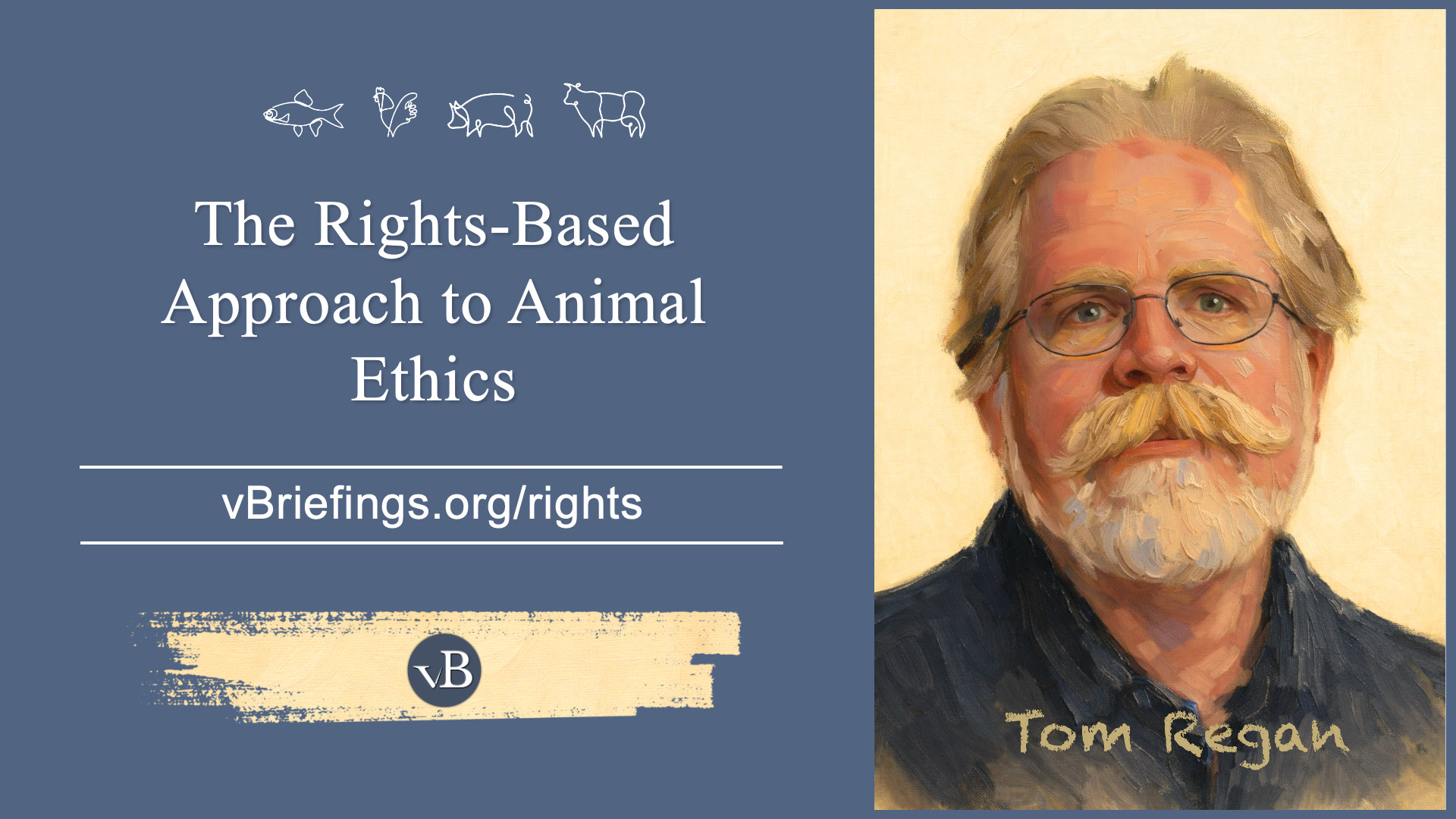
Also, briefing URLs (with slugs) are prominently displayed in the social sharing image, giving users another chance to take note of and remember the briefing’s URL. Here is an example of a social sharing image:
Two Word Slugs
When a single-word slug would be ambiguous or confusing, use a hyphenated slug instead. For example, /pig-injustices distinguishes the page from similar briefings such as /pig-sentience and /cow-injustices.
Extra Redirects
If a singular slug like /omnivore is used, a redirect for /omnivores should be created to avoid confusion or failed attempts to guess the URL.
The same goes in reverse, but no redirect is needed for singular or plural forms that would be nonsensical. For example, for /rapport, no redirect is needed because /rapports is nonsensical.
Tech note: Redirects are managed in the Redirect Manager under the Tools menu in the WordPress Admin.
Excerpts
The excerpt serves a specific and consistent function within vBriefings: it tells the reader what the briefing will do for them. It is not merely a summary of the topic, nor is it a restatement of the title. Instead, it serves as an orientation tool, helping the reader quickly understand the purpose, scope, and usefulness of the briefing before deciding whether to engage with it. A well-crafted excerpt makes clear what the reader will gain—whether that is an overview, an explanation, an evaluation, or practical guidance.
It appears on all briefing listing pages and on the briefing page in the preface section:
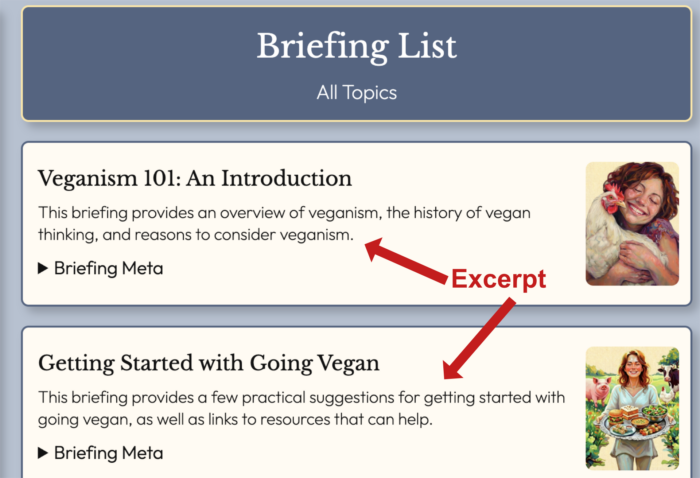
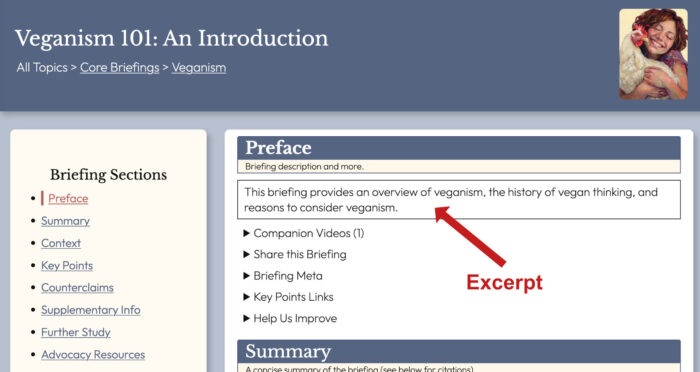
You should study the excerpts by perusing the Briefing Listing (the home page) to get a feel for how they are formulated. They are short and succinct—usually between 15 and 25 words, and up to 30 only if necessary. If longer, they are no longer easily read at a glance.
Although excerpts are brief, they follow a small number of recognizable patterns. The following are suggested patterns that have proven effective, though the list is not necessarily exhaustive:
- “This briefing…” followed by a clear verb that defines its function (e.g., provides, explains, shows, highlights). This is the most common form and is especially useful for general, introductory, or explanatory topics where clarity and framing are important.
- Direct declarative statement presenting the core claim without introductory phrasing. This is often used where the central point is well established or grounded in scientific or expert consensus.
- “We…” framing, which presents the briefing as an analysis or evaluation (e.g., “We examine…,” “We address…”), is typically used when engaging with objections or specific arguments.
- List-oriented phrasing, such as “Several points to consider,” signals a structured, multi-part discussion or evaluation.
Each excerpt should consist of a single sentence or sentence fragment, typically between 15 and 30 words. The goal is clarity at a glance. The sentence should be simple in structure, avoiding unnecessary complexity, multiple clauses, or stylistic flourishes.
Because the title already identifies the topic, the excerpt should avoid repeating it and instead add meaningful detail—often by naming one or two key elements included in the briefing, such as an overview, historical context, practical suggestions, or supporting resources.
The tone of the excerpt should remain neutral, precise, and informative. It should avoid exaggeration, emotional language, or promotional phrasing. Even when the subject matter is serious or the claims are strong, they should be stated plainly and proportionately.
Strong verbs are preferred over vague constructions; phrases such as “provides an overview,” “explains why,” or “examines the claim” communicate purpose more effectively than general terms like “discusses” or “talks about.”
Tech Note: In WordPress, an “excerpt” is typically automatically generated from the first 55 words of a post. In vBriefings, this field is always overridden and specified manually to ensure the description is concise, accurate, and effective. The term “excerpt” is retained for consistency with WordPress and related software documentation, even though it is not used in its default, automated sense.